Saturday, February 28, 2015
synod
A synod historically is a council of a church, usually convened to decide an issue of doctrine, administration or application. In modern usage, the word often refers to the governing body of a particular church, whether its members are meeting or not. It is also sometimes used to refer to a church that is governed by a synod.

Friday, February 27, 2015
Vulgate
The Vulgate is a late 4th-century Latin translation of the Bible. It was largely the work of St. Jerome, who was commissioned by Pope Damasus I in 382 to make a revision of the old Latin translations. By the 13th century this revision had come to be called the versio vulgata, that is, the "commonly used translation", and ultimately it became the definitive and officially promulgated Latin version of the Bible in the Roman Catholic Church. Its widespread adoption led to the eclipse of earlier Latin translations, which are collectively referred to as the Vetus Latina.
Thursday, February 26, 2015
Masoretic Text
The Masoretic Text (MT, 𝕸, or  ) is the authoritative Hebrew text of the Jewish Bible. While the Masoretic Text defines the books of the Jewish canon, it also defines the precise letter-text of these biblical books, with their vocalization and accentuation known as the Masorah. The MT is also widely used as the basis for translations of the Old Testament in Protestant Bibles, and in recent years (since 1943) also for some Catholic Bibles, although the Eastern Orthodox continue to use the Septuagint, as they hold it to be divinely inspired. In modern times the Dead Sea Scrolls have shown the MT to be nearly identical to some texts of the Tanakh dating from 200 BCE but different from others.
) is the authoritative Hebrew text of the Jewish Bible. While the Masoretic Text defines the books of the Jewish canon, it also defines the precise letter-text of these biblical books, with their vocalization and accentuation known as the Masorah. The MT is also widely used as the basis for translations of the Old Testament in Protestant Bibles, and in recent years (since 1943) also for some Catholic Bibles, although the Eastern Orthodox continue to use the Septuagint, as they hold it to be divinely inspired. In modern times the Dead Sea Scrolls have shown the MT to be nearly identical to some texts of the Tanakh dating from 200 BCE but different from others.
Wednesday, February 25, 2015
Tebet
Tebet (Hebrew: טֵבֵת, Standard Tevet; Sephardim/Yemenite/Mizrachim "Tebeth"; Ashkenazi Teves; Tiberian Ṭēḇēṯ; from Akkadian ṭebētu) is the fourth month of the civil year and the tenth month of the ecclesiastical year on the Hebrew calendar. It follows Kislev and precedes Shevat. It is a winter month of 29 days. Tebet usually occurs in December–January on the Gregorian calendar.
Tuesday, February 24, 2015
Septuagint
The Septuagint, or simply "LXX", or the "Greek Old Testament", is a translation into Koine Greek of the Hebrew Bible and some related texts that are not included in the Hebrew Bible canon. It incorporates the oldest of several ancient translations of what are now the Christian Old Testament, Biblical apocrypha and Deuterocanonical books. The LXX is referred to in critical works by the abbreviation  or G.
or G.
or G.
Monday, February 23, 2015
Anno Mundi
Anno Mundi (Latin: "in the year of the world"), abbreviated as AM or A.M., refers to a Calendar era based on the Biblical creation of the world. Numerous efforts have been made to determine the Biblical date of Creation, yielding varying results. Besides differences in interpretation, which version of the Bible is being referenced also impacts on the result. (see Dating creation)
The Hebrew calendar era is used within the Jewish communities for religious and other purposes; and the Byzantine calendar has been in general use at one time in the Orthodox Churches and several Eastern European countries.
Sunday, February 22, 2015
crannog
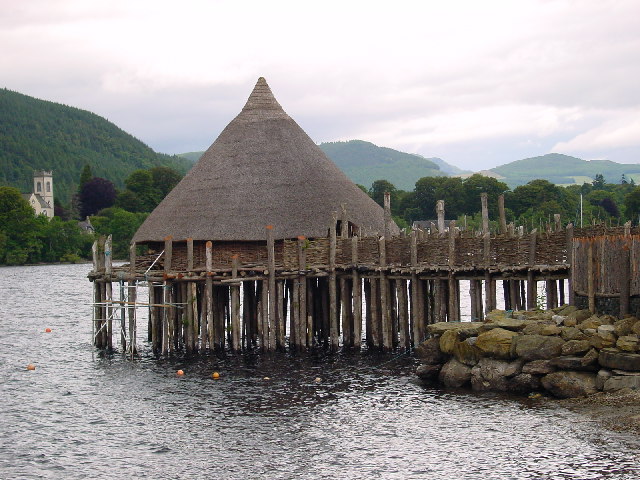
A crannog is typically a partially or entirely artificial island, usually built in lakes, rivers and estuarine waters of Scotland and Ireland. Crannogs were used as dwellings over five millennia from the European Neolithic Period, to as late as the 17th/early 18th century although in Scotland, convincing evidence for Early and Middle Bronze Age or Norse Period use is not currently present in the archaeological record.
The earliest radiocarbon determinations obtained from key sites such as Oakbank in Loch Tay or Redcastle, Beauly Firth approach the Late Bronze Age - Early Iron Age transition at their widest interpretation at 2 sigma or 95.4% probability, falling after c.800BC and therefore could only be considered Late Bronze Age by the narrowest of margins. Crannogs have been variously interpreted as free-standing wooden structures, as at Loch Tay, although more commonly they exist as brush, stone or timber mounds which can be revetted with timber piles. However, in areas such as the Western Isles of Scotland, timber was unavailable from the Neolithic onwards. As a result, completely stone crannogs supporting drystone architecture are common here. Today, crannogs typically appear as small, circular islets, often 10 to 30 metres (30 to 100 ft) in diameter, covered in dense vegetation due to their inaccessibility to grazing livestock.
Subscribe to:
Posts (Atom)
synanthrope
A synanthrope (from ancient Greek σύν sýn "together, with" and ἄνθρωπος ánthrōpos "man") is an organism that evolve...

-
A canary trap is a method for exposing an information leak by giving different versions of a sensitive document to each of several suspec...
-
A synanthrope (from ancient Greek σύν sýn "together, with" and ἄνθρωπος ánthrōpos "man") is an organism that evolve...
-
 A kouros (plural kouroi , Ancient Greek κοῦρος ) is the modern term given to those representations of male youths which first appear i...

