Pachycauls are plants with a disproportionately thick trunk for their height, and few branches. In contrast, trees with thin twigs such as Oak (Quercus), Maple (Acer) and Eucalyptus are called leptocauls while those with moderately thick twigs like Plumeria are called mesocauls. Pachycauly can be the product of exceptional primary growth (as with palms and cycads) or disproportionate secondary growth as with the Baobabs (Adansonia). The word is derived from the Greek pachy- meaning thick or stout, and Latin caulis meaning the stem.
Thursday, November 16, 2023
Wednesday, November 15, 2023
Monday, May 1, 2023
bract
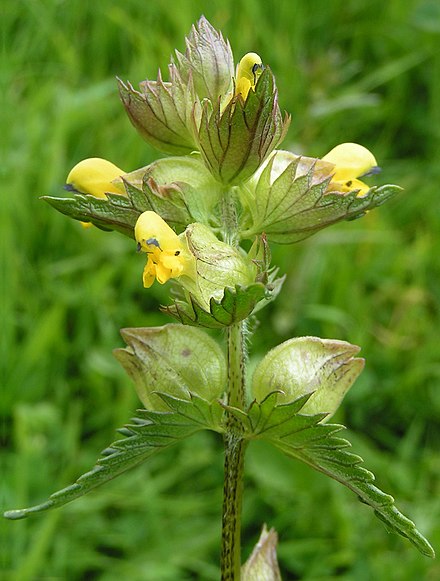
In botany, a bract is a modified or specialized leaf, especially one associated with a reproductive structure such as a flower, inflorescence axis or cone scale. Bracts are usually different from foliage leaves. They may be smaller, larger, or of a different color, shape, or texture. Typically, they also look different from the parts of the flower, such as the petals or sepals.
Tuesday, April 25, 2023
Marcescence
Marcescence is the withering and persistence of plant organs that normally are shed, and is a term most commonly applied to plant leaves.
Monday, April 24, 2023
Monday, May 2, 2022
hilum
In botany, a hilum (pronounced /ˈhaɪləm/) is a scar or mark left on a seed coat by the former attachment to the ovary wall or to the funiculus (which in turn attaches to the ovary wall). On a bean seed, the hilum is called the "eye".
For some species of fungus, the hilum is the microscopic indentation left on a spore when it separates from the sterigma of the basidium.
Tuesday, September 14, 2021
Sunday, July 11, 2021
Sunday, October 27, 2019
Thursday, July 16, 2015
prolepsis
prolepsis (plural prolepses) NOUN
- (rhetoric) The assignment of something to a period of time that precedes it.
- (logic) The anticipation of an objection to an argument.
- (grammar, rhetoric) A construction that consists of placing an element in a syntactic unit before that to which it would logically correspond.
- (philosophy, epistemology) A so-called "preconception", i.e. a pre-theoretical notion which can lead to true knowledge of the world.
- (botany) Growth in which lateral branches develop from a lateral meristem, after the formation of a bud or following a period of dormancy, when the lateral meristem is split from a terminal meristem.
Friday, May 1, 2015
Integument
"Integument", as a word, derives from the Latin "integumentum", which literally means "a covering". In transferred or figurative senses, it could mean a cloak or a disguise. In English "integument" is a fairly modern word, its origin having been traced back to the early seventeenth century. It can mean a material or layer with which anything is enclosed, clothed, or covered in the sense of "clad" or "coated", as with a skin or husk.
As a general term in biology the word "integument" refers most commonly to the natural covering of an organism or an organ, such as its skin, husk, shell, or rind.In botany the senses are similar to those in zoology, referring to the covering of an organ, but when the context indicates nothing to the contrary, the word commonly refers to an envelope of one or more cell layers covering the ovule, leaving only a pore, the micropyle, through which the pollen tube can enter. It also can refer to the testa, or seed coat.
The integument of an organ in zoology typically would comprise membranes of connective tissue such as those around a kidney or liver. In referring to the integument of an animal, the usual sense is its skin and its derivatives: the integumentary system, where "integumentary" is a simile for "cutaneous".
Wednesday, February 4, 2009
synanthrope
A synanthrope (from ancient Greek σύν sýn "together, with" and ἄνθρωπος ánthrōpos "man") is an organism that evolve...
-
A canary trap is a method for exposing an information leak by giving different versions of a sensitive document to each of several suspec...
-
A synanthrope (from ancient Greek σύν sýn "together, with" and ἄνθρωπος ánthrōpos "man") is an organism that evolve...
-
A kouros (plural kouroi , Ancient Greek κοῦρος ) is the modern term given to those representations of male youths which first appear i...