In astronomy, a syzygy (/ˈsɪzədʒi/ SIZ-ə-jee; from Ancient Greek συζυγία (suzugía) 'union, yoke') is a roughly straight-line configuration of three or more celestial bodies in a gravitational system.

In astronomy, a syzygy (/ˈsɪzədʒi/ SIZ-ə-jee; from Ancient Greek συζυγία (suzugía) 'union, yoke') is a roughly straight-line configuration of three or more celestial bodies in a gravitational system.
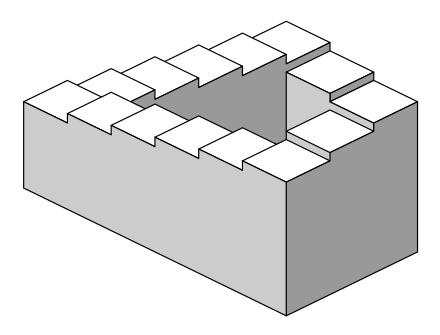
The Penrose stairs or Penrose steps, also dubbed the impossible staircase, is an impossible object created by Oscar Reutersvärd in 1937 and later independently discovered and made popular by Lionel Penrose and his son Roger Penrose. A variation on the Penrose triangle, it is a two-dimensional depiction of a staircase in which the stairs make four 90-degree turns as they ascend or descend yet form a continuous loop, so that a person could climb them forever and never get any higher. This is clearly impossible in three-dimensional Euclidean geometry but possible in some non-eucliean geometry like in nil geometry.

In geometry, a pentahedron (plural: pentahedra) is a polyhedron with five faces. Since there are no face-transitive polyhedra with five sides and there are two distinct topological types, this term is less frequently used than tetrahedron or octahedron.
With regular polygon faces, the two topological forms types are the square pyramid and triangular prism. Geometric variations with irregular faces can also be constructed.

In geometry, the rhombicosidodecahedron, or small rhombicosidodecahedron, is an Archimedean solid, one of thirteen convex isogonal nonprismatic solids constructed of two or more types of regular polygon faces.
It has 20 regular triangular faces, 30 square faces, 12 regular pentagonal faces, 60 vertices and 120 edges.
The name rhombicosidodecahedron refers to the fact that the 30 square faces lie in the same planes as the 30 faces of the rhombic triacontahedron which is dual to the icosidodecahedron.
It can also be called an expanded or cantellated dodecahedron or icosahedron, from truncation operations on either uniform polyhedron.


 In mathematics, a toroid is a doughnut-shaped object, such as an O-ring. Its annular shape is generated by revolving a geometrical figure around an axis external to that figure. When a rectangle is rotated around an axis parallel to one of its edges then a hollow cylinder (resembling a piece of straight pipe) is produced.
 If the revolved figure is a circle, then the surface of such an object is known as a torus.

A synanthrope (from ancient Greek σύν sýn "together, with" and ἄνθρωπος ánthrōpos "man") is an organism that evolve...


