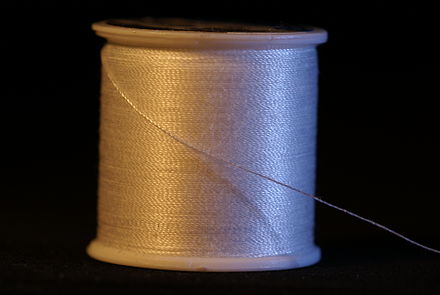
Mercerisation is a textile finishing treatment for cellulose fabric and yarn, mainly cotton and flax, which improves dye uptake and tear strength, reduces fabric shrinkage, and imparts a silk-like luster.
Showing posts with label colour. Show all posts
Tuesday, January 3, 2023
Monday, April 12, 2021
qualia
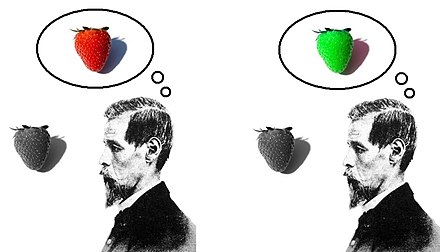
In philosophy and certain models of psychology, qualia (/ˈkwɑːliə/ or /ˈkweɪliə/; singular form: quale) are defined as individual instances of subjective, conscious experience.
Sunday, August 2, 2015
Eigengrau
Eigengrau (German: "intrinsic gray"), also called Eigenlicht ("intrinsic light"), dark light, or brain gray,
is a term for the uniform dark gray background that many people report
seeing in the absence of light. The term dates back to the nineteenth
century, but has rarely
been used in recent scientific publications. A literature search finds
that the most recent mention of the term in a scientific journal article
dates from the year 2000. Nowadays the phenomenon is more commonly referred to as "visual noise" or "background adaptation".
Eigengrau is perceived as lighter than a black object in normal lighting conditions, because contrast is more important to the visual system than absolute brightness. For example, the night sky looks darker than eigengrau because of the contrast provided by the stars.
Researchers noticed early on that the shape of intensity-sensitivity curves could be explained by assuming that an intrinsic source of noise in the retina produces random events indistinguishable from those triggered by real photons. Later experiments on rod cells of cane toads (Bufo marinus) showed that the frequency of these spontaneous events is strongly temperature-dependent, which implies that they are caused by the thermal isomerization of rhodopsin. In human rod cells, these events occur about once every 100 seconds on average, which, taking into account the number of rhodopsin molecules in a rod cell, implies that the half-life of a rhodopsin molecule is about 420 years. The indistinguishability of dark events from photon responses supports this explanation, because rhodopsin is at the input of the transduction chain. On the other hand, processes such as the spontaneous release of neurotransmitters cannot be completely ruled out.
Eigengrau is perceived as lighter than a black object in normal lighting conditions, because contrast is more important to the visual system than absolute brightness. For example, the night sky looks darker than eigengrau because of the contrast provided by the stars.
Researchers noticed early on that the shape of intensity-sensitivity curves could be explained by assuming that an intrinsic source of noise in the retina produces random events indistinguishable from those triggered by real photons. Later experiments on rod cells of cane toads (Bufo marinus) showed that the frequency of these spontaneous events is strongly temperature-dependent, which implies that they are caused by the thermal isomerization of rhodopsin. In human rod cells, these events occur about once every 100 seconds on average, which, taking into account the number of rhodopsin molecules in a rod cell, implies that the half-life of a rhodopsin molecule is about 420 years. The indistinguishability of dark events from photon responses supports this explanation, because rhodopsin is at the input of the transduction chain. On the other hand, processes such as the spontaneous release of neurotransmitters cannot be completely ruled out.
Sunday, May 1, 2011
Chromatophores

Chromatophores are pigment-containing and light-reflecting cells found in amphibians, fish, reptiles, crustaceans, and cephalopods. They are largely responsible for generating skin and eye colour in cold-blooded animals and are generated in the neural crest during embryonic development. Mature chromatophores are grouped into subclasses based on their colour (more properly "hue") under white light: xanthophores (yellow), erythrophores (red), iridophores (reflective / iridescent), leucophores (white), melanophores (black/brown) and cyanophores (blue). The term can also refer to coloured, membrane associated vesicles found in some forms of photosynthetic bacteria.
Tuesday, August 10, 2010

Celeste is a bluey-greenish colour. Bianchi bicycles are traditionally painted celeste, a turquoise also known as Bianchi green, although there are other colours. Contradictory myths say celeste is the colour of the Milan sky, the eye colour of a former queen of Italy for whom Edoardo Bianchi made a bicycle - the crowned eagle of the company logo is an adaptation of the former royal crest - and that it was a mixture of surplus military paint. The shade has changed over the years, sometimes more blue, then more green.
Saturday, August 22, 2009
Truecolor
Truecolor is a method of representing and storing graphical image information (especially in computer processing) in an RGB color space such that a very large number of colors, shades, and hues can be displayed in an image, such as in high quality photographic images or complex graphics. Usually, truecolor is defined to mean at least 256 shades of red, green, and blue, for a total of at least 16,777,216 color variations. Equivalently, truecolor can refer to an RGB display mode that does not need a color look-up table (CLUT).
Wednesday, June 10, 2009
Subscribe to:
Posts (Atom)
synanthrope
A synanthrope (from ancient Greek σύν sýn "together, with" and ἄνθρωπος ánthrōpos "man") is an organism that evolve...
-
A canary trap is a method for exposing an information leak by giving different versions of a sensitive document to each of several suspec...
-
Nureongi (누렁이) and Hwangu (황구; 黃狗) are Korean terms meaning "Yellow Dog" used to refer to tannish mongrel or landrace of dog in...
-
A hyperforeignism is a type of qualitative hypercorrection that involves speakers misidentifying the distribution of a pattern found in ...