Showing posts with label mineral. Show all posts

Monday, March 20, 2023

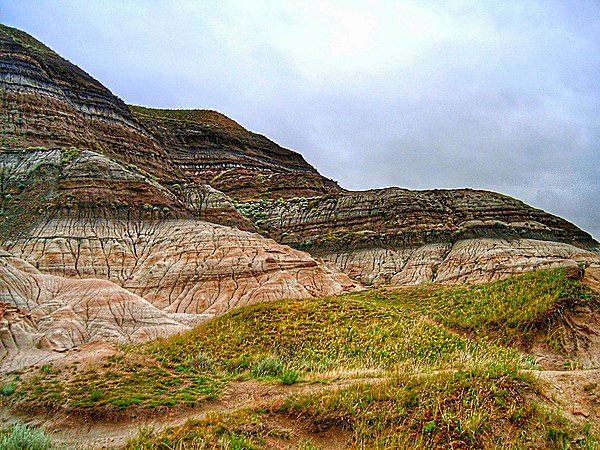
K–Pg boundary

 The Cretaceous–Paleogene (K–Pg) boundary, formerly known as the Cretaceous–Tertiary (K–T) boundary, is a geological signature, usually a thin band of rock containing much more iridium than other bands. The K–Pg boundary marks the end of the Cretaceous Period, the last period of the Mesozoic Era, and marks the beginning of the Paleogene Period, the first period of the Cenozoic Era. Its age is usually estimated at around 66 million years, with radiometric dating yielding a more precise age of 66.043 ± 0.011 Ma.


Thursday, May 26, 2022

Cinnabar

 Cinnabar (/ˈsɪnəˌbɑːr/) or cinnabarite (/sɪnəˈbɑːraɪt/), from the Ancient Greek: κιννάβαρι (kinnabari), is the bright scarlet to brick-red form of mercury(II) sulfide (HgS). It is the most common source ore for refining elemental mercury, and is the historic source for the brilliant red or scarlet pigment termed vermilion and associated red mercury pigments


Tuesday, February 4, 2014

Ilmenite

Ilmenite is a weakly magnetic titanium-iron oxide mineral which is iron-black or steel-gray. It is a crystalline iron titanium oxide (FeTiO3). It crystallizes in the trigonal system, and it has the same crystal structure as corundum and hematite.

Sunday, February 2, 2014

Dunite

Dunite is an igneous, plutonic rock, of ultramafic composition, with coarse-grained or phaneritic texture. The mineral assemblage is greater than 90% olivine, with minor amounts of other minerals such as pyroxene, chromite and pyrope. Dunite is the olivine-rich end-member of the peridotite group of mantle-derived rocks. Dunite and other peridotite rocks are considered the major constituents of the Earth's mantle above a depth of about 400 kilometers. Dunite is rarely found within continental rocks, but where it is found, it typically occurs at the base of ophiolite sequences where slabs of mantle rock from a subduction zone have been thrust onto continental crust by obduction during continental or island arc collisions (orogeny). It is also found in alpine peridotite massifs that represent slivers of sub-continental mantle exposed during collisional orogeny. Dunite typically undergoes retrograde metamorphism in near-surface environments and is altered to serpentinite and soapstone.

Saturday, January 4, 2014

Cummingtonite


Cummingtonite is a metamorphic amphibole with the chemical composition (Mg,Fe)7Si8O22(OH)2, magnesium iron silicate hydroxide.

Monoclinic cummingtonite is compositionally similar and polymorphic with orthorhombic anthophyllite, which is a much more common form of magnesium-rich amphibole, the latter being metastable.

Cummingtonite shares few compositional similarities with alkali amphiboles such as arfvedsonite, glaucophane-riebeckite. There is little solubility between these minerals due to different crystal habit and inability of substitution between alkali elements and ferro-magnesian elements within the amphibole structure.

Monday, August 12, 2013

Fluorellestadite

Fluorellestadite is a rare nesosilicate of calcium, with sulfate and fluorine, with the chemical formula Ca10(SiO4)3(SO4)3F2.[1] It is a member of the apatite group, and forms a series with hydroxylellestadite.

Saturday, August 3, 2013

Glauconite


Glauconite is an iron potassium phyllosilicate (mica group) mineral of characteristic green color with very low weathering resistance and very friable.

It crystallizes with a monoclinic geometry. Its name is derived from the Greek glaucos (γλαυκος) meaning 'gleaming' or 'silvery', to describe the appearance of the blue-green color, presumably relating to the sheen and blue-green color of the sea's surface. Its color ranges from olive green, black green to bluish green. In the Mohs scale it has hardness of 2. The relative specific gravity range is 2.4 - 2.95. It is normally found in dark green rounded pellets with the dimension of a sand grain size. It can be confused with chlorite (also of green color) or with some other clay minerals.

Monday, April 22, 2013

Lustre

Lustre (or luster) is a description of the way light interacts with the surface of a crystal, rock, or mineral. The word lustre traces its origins back to the Latin word lux, meaning "light", and generally implies radiance, gloss, or brilliance.

A range of terms are used to describe lustre. Many terms refer to materials having similar lustres, such as earthy, metallic, greasy, and silky. Similarly, the term vitreous (derived from the Latin for glass, vitrum) refers to a glassy lustre. A list of these terms is given below.

Friday, March 1, 2013

Fluorite


Fluorite (also called fluorspar) is a halide mineral composed of calcium fluoride, CaF2. It is an isometric mineral with a cubic habit, though octahedral and more complex isometric forms are not uncommon. Crystal twinning is common and adds complexity to the observed crystal habits.

The word fluorite is derived from the Latin root fluo, meaning "to flow" because the mineral is used in iron smelting as a flux to decrease the viscosity (increase the fluidity) of slags at a given temperature. This increase in fluidity is the result of the ionic nature of the mineral. The melting point of pure calcium fluoride is 1676 K.

Friday, May 11, 2012

Stakhanovite


In Soviet history and iconography, a Stakhanovite (стахановец) follows the example of Aleksei Grigorievich Stakhanov, employing hard work or Taylorist efficiencies to over-achieve on the job.

The Stakhanovite movement began during the second 5-year plan in 1935 as a new stage of the socialist competition. The Stakhanovite movement was named after Aleksei Stakhanov, who had mined 102 tons of coal in less than 6 hours (14 times his quota).

Sunday, February 28, 2010

Bauxite


Bauxite is the most important aluminium ore. It consists largely of the minerals gibbsite Al(OH)3, boehmite γ-AlO(OH), and diaspore α-AlO(OH), together with the iron oxides goethite and hematite, the clay mineral kaolinite and small amounts of anatase TiO2. It was named after the village Les Baux in southern France, where it was first discovered in 1821 by the geologist Pierre Berthier.

Bauxite is strip mined (surface mining) because it is found at the surface, with little or no overburden. Approximately 95% of the world's bauxite production is processed into aluminium. Bauxites are typically classified according to their intended commercial application: metallurgical, abrasive, cement, chemical and refractory.

synanthrope

 A synanthrope (from ancient Greek σύν sýn "together, with" and ἄνθρωπος ánthrōpos "man") is an organism that evolve...