Compsognathidae is a family of coelurosaurian theropod dinosaurs. Compsognathids were small carnivores, generally conservative in form, hailing from the Jurassic and Cretaceous Periods.
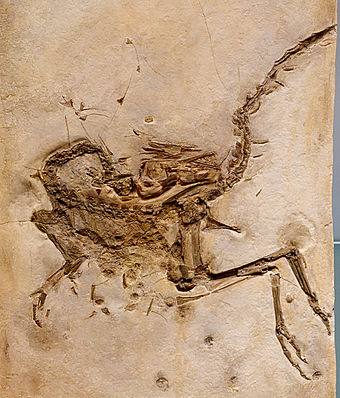
Compsognathidae is a family of coelurosaurian theropod dinosaurs. Compsognathids were small carnivores, generally conservative in form, hailing from the Jurassic and Cretaceous Periods.
The Cretaceous–Paleogene (K–Pg) boundary, formerly known as the Cretaceous–Tertiary (K–T) boundary, is a geological signature, usually a thin band of rock containing much more iridium than other bands. The K–Pg boundary marks the end of the Cretaceous Period, the last period of the Mesozoic Era, and marks the beginning of the Paleogene Period, the first period of the Cenozoic Era. Its age is usually estimated at around 66 million years, with radiometric dating yielding a more precise age of 66.043 ± 0.011 Ma.
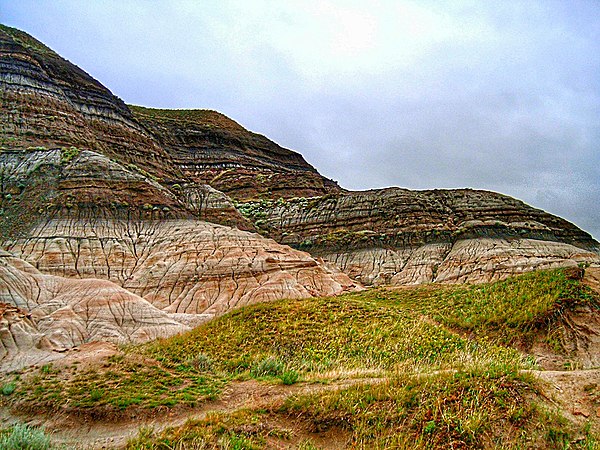

The Jurassic is a geologic period and system that extends from about 199.6± 0.6 Mya (million years ago) to 145.5± 4 Mya, that is, from the end of the Triassic to the beginning of the Cretaceous. The Jurassic constitutes the middle period of the Mesozoic Era, also known as the Age of Reptiles. The start of the period is marked by the major Triassic–Jurassic extinction event. However, the end of the Jurassic Period did not witness any major extinction event. The start and end of the period are defined by carefully selected locations; the uncertainty in dating arises from trying to date these horizons.
The chronostratigraphic term "Jurassic" is directly linked to the Jura Mountains. Alexander von Humboldt recognized the mainly limestone dominated mountain range of the Jura Mountains as a separate formation that was not at the time included in the established stratigraphic system defined by Abraham Gottlob Werner and named it “Jurakalk” in 1795. The name “Jura” is derived from the celtic root “jor” which was Latinised into “juria”, meaning forest (i.e. “Jura” is forest mountains).Zhuchengtyrannus (meaning "Zhucheng tyrant") is a genus of carnivorous theropod dinosaur from the Late Cretaceous period. It is a tyrannosaurine tyrannosaurid which lived during the late Cretaceous period in what is now Zhucheng, Shandong Province of China. It is known from a maxilla and associated dentary (lower jaw with teeth) recovered from the Wangshi Group, dating to about 70 million years ago. It was one of the largest known carnivorous theropods, measuring about 11 m (36 ft) in length, 4 metres (13 ft) tall, and 6 tons in weight. The dentary is only a little smaller than the largest Tyrannosaurus rex jawbone found.
The place where the dinosaur has been found was a flood plain in the Cretaceous period and contains one of the highest concentrations of dinosaur bones in the world.
Albertosaurus (meaning "Alberta lizard") is a genus of tyrannosaurid theropod dinosaur that lived in western North America during the Late Cretaceous Period, more than 70 million years ago. The type species, A. sarcophagus, was restricted in range to the modern-day Canadian province of Alberta, after which the genus is named. Scientists disagree on the content of the genus, with some recognizing Gorgosaurus libratus as a second species.
As a tyrannosaurid, Albertosaurus was a bipedal predator with tiny, two-fingered hands and a massive head with dozens of large, sharp teeth. It may have been at the top of the food chain in its local ecosystem. Although relatively large for a theropod, Albertosaurus was much smaller than its more famous relative Tyrannosaurus, probably weighing less than 2 metric tons.


A synanthrope (from ancient Greek σύν sýn "together, with" and ἄνθρωπος ánthrōpos "man") is an organism that evolve...


