elsewhen (not comparable)
(archaic) At some other time or times; somewhen else.
Havishamesque (comparative more Havishamesque, superlative most Havishamesque)
Stuck in the past; also, refusing to accept change or failure.

occasive (not comparable)

A retronym is a newer name for an existing thing that helps differentiate the original form from a more recent one. It is thus a word or phrase created to avoid confusion between older and newer types, whereas previously (before there were more than one type) no clarification was required.
Advances in technology are often responsible for the coinage of retronyms. For example, the term acoustic guitar was coined with the advent of electric guitars; analog watches were renamed to distinguish them from digital watches once the latter were invented; and "push bike" was created to distinguish from motorbikes and motorized bicycles; finally "feature phone" was also coined behind smartphones.
The global war of the early 20th Century from 1914 to 1918 was referred to at the time as the "Great War". However, after World War II (also known as the Second World War) erupted in 1939, the Great War was gradually more commonly referred to instead as World War I or the First World War.
The first bicycles with two wheels of equal size were called "safety bicycles" because they were easier to handle than the then-dominant style that had one large wheel and one small wheel, which then became known as an "ordinary" bicycle.
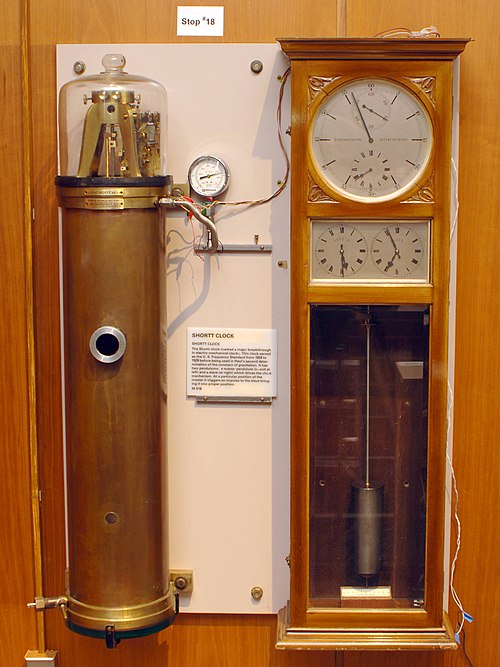
The Shortt–Synchronome free pendulum clock is a complex precision electromechanical pendulum clock invented in 1921 by British railway engineer William Hamilton Shortt in collaboration with horologist Frank Hope-Jones.
A chronozone or chron is a unit in chronostratigraphy, defined by events such as geomagnetic reversals (magnetozones), or based on the presence of specific fossils (biozone or biochronozone). According to the International Commission on Stratigraphy, the term "chronozone" refers to the rocks formed during a particular time period, while "chron" refers to that time period.
.jpg/440px-Quebrada_de_Cafayate%2C_Salta_(Argentina).jpg)

An indiction is any of the years in a 15-year cycle used to date medieval documents throughout Europe, both East and West. Each year of a cycle was numbered: first indiction, second indiction, etc. However, the cycles were not numbered, thus other information is needed to identify the specific year.
When the term began to be used, it referred only to the full cycle, and individual years were referred to as being Year 1 of the indiction, Year 2 of the indiction, etc. But usage changed, and it gradually became common to talk of the 1st indiction, the 2nd indiction, and so on.
Anno Mundi (Latin: "in the year of the world"), abbreviated as AM or A.M., refers to a Calendar era based on the Biblical creation of the world. Numerous efforts have been made to determine the Biblical date of Creation, yielding varying results. Besides differences in interpretation, which version of the Bible is being referenced also impacts on the result. (see Dating creation)
The Hebrew calendar era is used within the Jewish communities for religious and other purposes; and the Byzantine calendar has been in general use at one time in the Orthodox Churches and several Eastern European countries.
Shortened form of “of the clock” or “on the clock”; that is, “according to the clock”.
A synanthrope (from ancient Greek σύν sýn "together, with" and ἄνθρωπος ánthrōpos "man") is an organism that evolve...


