The pratincoles or greywaders are a group of birds which together with the coursers make up the family Glareolidae. They have short legs, very long pointed wings and long forked tails.
_Photograph_by_Shantanu_Kuveskar.jpg/440px-Small_Indian_pratincole_(Glareola_lactea)_Photograph_by_Shantanu_Kuveskar.jpg)
The pratincoles or greywaders are a group of birds which together with the coursers make up the family Glareolidae. They have short legs, very long pointed wings and long forked tails.
Extra-pair copulation (EPC) is a mating behaviour in monogamous species. Monogamy is the practice of having only one sexual partner at any one time, forming a long-term bond and combining efforts to raise offspring together; mating outside this pairing is extra-pair copulation.

Extra-pair copulation is common in birds. For example, zebra finches, although socially monogamous, are not sexually monogamous and hence do engage in extra-pair courtship and attempts at copulation.
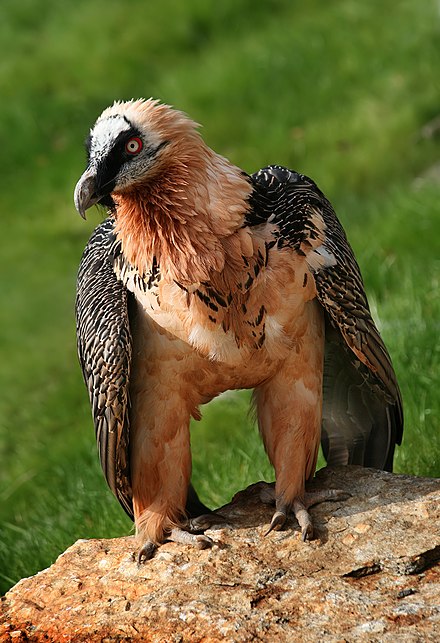
The bearded vulture (Gypaetus barbatus), also known as the lammergeier and ossifrage, is a very large bird of prey and the only member of the genus Gypaetus. Traditionally considered an Old World vulture, it actually forms a separate minor lineage of Accipitridae together with the Egyptian vulture (Neophron percnopterus), its closest living relative. It is not much more closely related to the Old World vultures proper than to, for example, hawks, and differs from the former by its feathered neck. Although dissimilar, the Egyptian and bearded vulture each have a lozenge-shaped tail—unusual among birds of prey. It is vernacularly known as Homa, a divine bird in Iranian mythology.
Etymology is uncertain. In 2007 it was speculated that the derivation was a mishearing of "heraldic".
horaltic (comparative more horaltic, superlative most horaltic)

Oology (or oölogy) is a branch of ornithology studying bird eggs, nests and breeding behaviour. The word is derived from the Greek oion, meaning egg. Oology can also refer to the hobby of collecting wild birds' eggs, sometimes called egg collecting, birdnesting or egging, which is now illegal in many jurisdictions.

Egg collecting was still popular in the early 20th century, even as its scientific value became less prominent. Egg collectors built large collections and traded with one another. Frequently, collectors would go to extreme lengths to obtain eggs of rare birds. For example, Charles Bendire was willing to have his teeth broken to remove a rare egg that became stuck in his mouth. He had placed the egg in his mouth while climbing down a tree.
Icterids (/ˈɪktərɪd/) or New World blackbirds make up a family, the Icteridae (/ɪkˈtɛrɪdi/), of small to medium-sized, often colorful, New World passerine birds.

Most species have black as a predominant plumage color, often enlivened by yellow, orange, or red. The species in the family vary widely in size, shape, behavior, and coloration. The name, meaning "jaundiced ones" (from the prominent yellow feathers of many species) comes from the Ancient Greek ikteros via the Latin ictericus.
_(cropped).jpg/440px-Bobolink_(27239680521)_(cropped).jpg)
This group includes the New World blackbirds, New World orioles, the bobolink, meadowlarks, grackles, cowbirds, oropendolas, and caciques.
A passerine (/ˈpæsəraɪn/) is any bird of the order Passeriformes (/ˈpæsərɪfɔːrmiːz/; from Latin passer 'sparrow' and formis '-shaped'), which includes more than half of all bird species.

The dickcissel (Spiza americana) is a small seed-eating bird in the family Cardinalidae. It breeds on the prairie grasslands of the Midwestern United States and winters in Central America, northern Colombia, and northern Venezuela. It is the only member of the genus Spiza, though some sources list another supposedly extinct species.


Currawongs are three species of medium-sized passerine birds belonging to the genus Strepera in the family Artamidae native to Australasia. These are the Grey Currawong (Strepera versicolor), Pied Currawong (S. graculina), and Black Currawong (S. fuliginosa). The common name comes from the call of the familiar Pied Currawong of eastern Australia and is onomatopoeic. They were formerly known as Crow-shrikes or Bell-magpies.
Despite their resemblance to crows and ravens, they are only distantly related to the corvidae, instead belonging to an Afro-Asian radiation of birds termed the Malaconotoidea.

A synanthrope (from ancient Greek σύν sýn "together, with" and ἄνθρωπος ánthrōpos "man") is an organism that evolve...


