Showing posts with label structure. Show all posts

Sunday, February 22, 2015

crannog


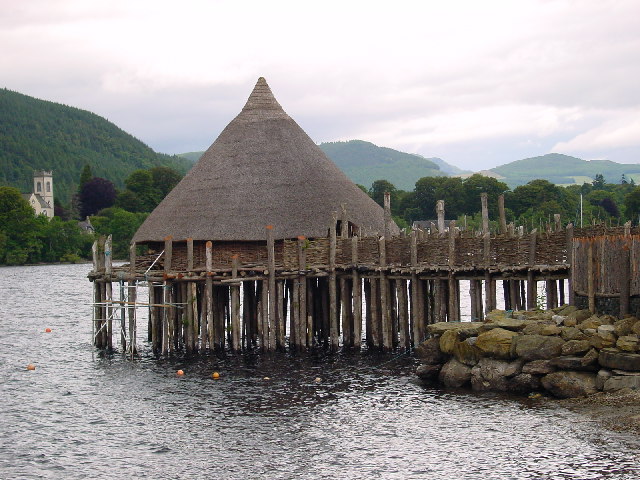
A crannog is typically a partially or entirely artificial island, usually built in lakes, rivers and estuarine waters of Scotland and Ireland. Crannogs were used as dwellings over five millennia from the European Neolithic Period, to as late as the 17th/early 18th century although in Scotland, convincing evidence for Early and Middle Bronze Age or Norse Period use is not currently present in the archaeological record.

The earliest radiocarbon determinations obtained from key sites such as Oakbank in Loch Tay or Redcastle, Beauly Firth approach the Late Bronze Age - Early Iron Age transition at their widest interpretation at 2 sigma or 95.4% probability, falling after c.800BC and therefore could only be considered Late Bronze Age by the narrowest of margins. Crannogs have been variously interpreted as free-standing wooden structures, as at Loch Tay, although more commonly they exist as brush, stone or timber mounds which can be revetted with timber piles. However, in areas such as the Western Isles of Scotland, timber was unavailable from the Neolithic onwards. As a result, completely stone crannogs supporting drystone architecture are common here. Today, crannogs typically appear as small, circular islets, often 10 to 30 metres (30 to 100 ft) in diameter, covered in dense vegetation due to their inaccessibility to grazing livestock.

Sunday, October 14, 2012

cantonment

A cantonment is a temporary or semi-permanent military or police quarters. The word cantonment is derived from the French word canton meaning corner or district (from which also the name of the Cantons of Switzerland is also derived) . In South Asia, the term cantonment also describes permanent military stations. Cantonments can be found in Bangladesh, India, Pakistan, South Africa, Singapore, Ghana, Sri Lanka and Nepal. In United States military parlance, a cantonment is an essentially permanent residential (i.e. barracks) section of a fort or other military installation such as, for example, Fort Hood.

The term is often abbreviated to "cantt."

Friday, December 30, 2011

machan

A bird hide (or hide) is a shelter, often camouflaged, that is used to observe wildlife, especially birds, at close quarters. Although hides were once built chiefly as a hunting aids, they are now commonly found in parks and wetlands for the use of bird watchers, ornithologists and other observers who do not want to disturb wildlife as it is being observed.

A typical bird hide resembles a garden shed, with small openings, shutters, or windows built into at least one side to enable observation.

Variant types of bird hide include:

  • the tower hide, which has multiple storeys and allows observations over large areas
  • the bird blind, which is a screen similar to one wall of a typical hide, with or without a roof for shelter
  • the machan, a covered platform erected to observe birds and wildlife in high trees or on cliffs, particularly in India where it was originally used by tiger-hunters.

Thursday, October 21, 2010

Urðarbrunnr


Urðarbrunnr (Old Norse "Well of Urðr"; either referring to a Germanic concept of fate—urðr—or the norn named Urðr) is a well in Norse mythology. Urðarbrunnr is attested in the Poetic Edda, compiled in the 13th century from earlier traditional sources, and the Prose Edda, written in the 13th century by Snorri Sturluson. In both sources, the well lies beneath the world tree Yggdrasil, and is associated with a trio of norns (Urðr, Verðandi, and Skuld). In the Prose Edda, Urðarbrunnr is cited as one of three wells existing beneath three roots of Yggdrasil that reach into three distant, different lands; the other two wells being Hvergelmir, located beneath a root in Niflheim, and Mímisbrunnr, located beneath a root near the home of the frost jötnar. Scholarly theory and speculation surrounds the well.

Sunday, October 3, 2010

Nadar

Nadar (Tamil: நாடார்) "Nadar" (also referred as Kshatriya Nadar, Nadan, Nataar, Gramani and Shanar) is one of the prominent castes of Tamil Nadu, South India.

Thursday, February 18, 2010

oceanarium


The term oceanarium is not well defined. It can either mean a marine mammal park such as Marineland of Florida or a large-scale aquarium such as the Lisbon Oceanarium presenting an ocean habitat with marine animals, especially large ocean dwellers (e.g. sharks).

synanthrope

 A synanthrope (from ancient Greek σύν sýn "together, with" and ἄνθρωπος ánthrōpos "man") is an organism that evolve...