Showing posts with label religion. Show all posts

Saturday, September 2, 2023

Æsir

 The Æsir are the gods of the principal pantheon in Old Norse religion and Norse mythology. The second Norse pantheon is the Vanir; these two pantheons waged war against each other, resulting in a unified pantheon. 


Sunday, August 13, 2023

Circumambulation


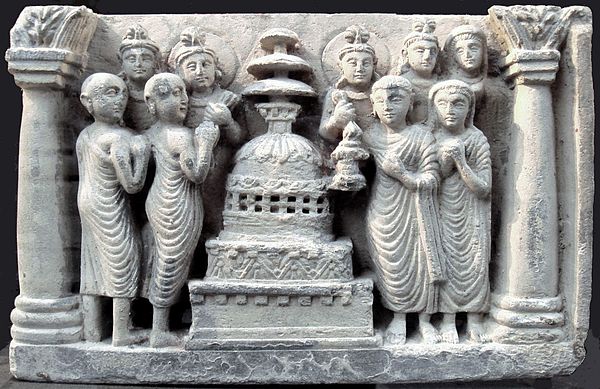
Circumambulation (from Latin circum around and ambulātus to walk) is the act of moving around a sacred object or idol.

Circumambulation of temples or deity images is an integral part of Hindu and Buddhist devotional practice (known in Sanskrit as pradakśiṇā). It is also present in other religions, including Christianity, Judaism, and Islam. 


Friday, February 17, 2023

Tzadikim Nistarim

 The Tzadikim Nistarim (Hebrew: צַדִיקִים נִסתָּרים, "hidden righteous ones") or Lamed Vav Tzadikim (Hebrew: ל"ו צַדִיקִים,x"36 righteous ones"), often abbreviated to Lamed Vav(niks), refers to 36 righteous people, a notion rooted within the mystical dimensions of Judaism. The singular form is Tzadik Nistar (Hebrew: צַדִיק נִסתָר). 

The existence of 36 righteous people is first mentioned in the Talmud:

There are no fewer than 36 righteous people in the world who greet the Shekhinah in each generation.

Monday, October 17, 2022

waqf

 A waqf (Arabic: وَقْف; [ˈwɑqf]), also known as hubous (حُبوس)[1] or mortmain property is an inalienable charitable endowment under Islamic law. It typically involves donating a building, plot of land or other assets for Muslim religious or charitable purposes with no intention of reclaiming the assets.

Thursday, September 29, 2022

Shaivism

 Shaivism (/ˈʃaɪvɪzəm/; Sanskrit: शैवसम्प्रदायः, Śaivasampradāyaḥ) is one of the major Hindu traditions that worships Shiva as the Supreme Being.


Sunday, May 29, 2022

Treif

 Treif (also written trayf, treyf or traif) is the Yiddish word that means “unkosher.”

Monday, May 9, 2022

Koinonia

 Koinonia (/ˌkɔɪnoʊˈniːə/) is a transliterated form of the Greek word κοινωνία, which refers to concepts such as fellowship, joint participation, the share which one has in anything, a gift jointly contributed, a collection, a contribution.

Wednesday, February 23, 2022

phylacteries

 Tefillin (/ˈtfɪlɪn/; Israeli Hebrew: תְּפִלִּין / תְּפִילִּין; Askhenazic pronunciation: [tfiˈlin]) or phylacteries, are a set of small black leather boxes with leather straps containing scrolls of parchment inscribed with verses from the Torah. Tefillin are worn by adult Jews during weekday morning prayers.

A set of Tefillin.jpg

Friday, September 17, 2021

Simony


Simony (/ˈsɪməni/) is the act of selling church offices and roles or sacred things. It is named after Simon Magus, who is described in the Acts of the Apostles as having offered two disciples of Jesus payment in exchange for their empowering him to impart the power of the Holy Spirit to anyone on whom he would place his hands. The term extends to other forms of trafficking for money in "spiritual things".

The appointment of ecclesiastical officials, such as bishops and abbots, by a secular authority came to be considered simoniacal and this became a key issue during the Investiture Controversy. 


Wednesday, September 15, 2021

altarpiece

 An altarpiece is an artwork such as a painting, sculpture or relief representing a religious subject made for placing behind the altar of a Christian church.


Thursday, August 26, 2021

Quakeress

 A quakeress is a human present participle for a human female Quaker.

Thursday, July 8, 2021

Tesgüino

 Tesgüino is an artisanal corn beer produced by several Yuto-Aztec people. The Tarahumara people regard the beer as sacred, and it forms a significant part of their society. Anthropologist John Kennedy reports that "the average Tarahumaras spends at least 100 days per year directly concerned with tesgüino and much of this time under its influence or aftereffects."

Saturday, March 27, 2021

Catharism

 Catharism (/ˈkæθərɪzəm/; from the Greek: καθαροί, katharoi, "the pure [ones]") was a Christian dualist or Gnostic movement between the 12th and 14th centuries which thrived in Southern Europe, particularly in northern Italy and southern France.

Thursday, January 21, 2021

legate

 A papal legate or apostolic legate (from the ancient Roman title legatus) is a personal representative of the pope to foreign nations, or to some part of the Catholic Church. He is empowered on matters of Catholic faith and for the settlement of ecclesiastical matters.
Monday, February 8, 2016

legate

A papal legate – from the Latin, authentic Roman title Legatus – is a personal representative of the pope to foreign nations, or to some part of the Catholic Church. He is empowered on matters of Catholic Faith and for the settlement of ecclesiastical matters.

Friday, January 8, 2016

Mammon

Mammon, in the New Testament of the Bible, is material wealth or greed, most often personified as a deity, and sometimes included in the seven princes of Hell.
File:The worship of Mammon.jpg

In the Bible, Mammon is personified in Luke 16:13, and Matthew 6:24, the latter verse repeating Luke 16:13. In the Greek, Luke 16:9, and Luke 16:11 also personify Mammon.
Early mentions of Mammon appear to stem from the personification in the Gospels, e.g., Didascalia, "Do solo Mammona cogitant, quorum Deus est sacculus"; and Saint Augustine, "Lucrum Punice Mammon dicitur" (Serm. on Mt., ii). Gregory of Nyssa also asserted that Mammon was another name for Beelzebub.
During the Middle Ages, Mammon was commonly personified as the demon of gluttony, richness, and injustice. Thus Peter Lombard (II, dist. 6) says, "Riches are called by the name of a devil, namely Mammon, for Mammon is the name of a devil, by which name riches are called according to the Syrian tongue." Piers Plowman also regards Mammon as a deity. Nicholas de Lyra (commenting on the passage in Luke) says: "Mammon est nomen daemonis" (Mammon is the name of a demon).

Monday, November 30, 2015

Peritus

Peritus (Latin for "expert") is the title given to Roman Catholic theologians who are present to give advice at an ecumenical council. At the most recent council, the Second Vatican Council, some periti (the plural form) accompanied individual bishops or groups of bishops from various countries. Others were formally appointed as advisers to the whole Council.
Father Joseph Ratzinger, formerly Pope Benedict XVI, served as peritus to Cardinal Josef Frings, Archbishop of Cologne, Germany, while Hans Küng was a peritus for the Council, rather than for an individual Bishop. The influential German theologian Father Karl Rahner S.J. served as peritus to Cardinal Franz König of Vienna. John Henry Newman refused an invitation to be a peritus at the First Vatican Council.
The periti often advocated ideas of reform in the Church and were often at the center of debates with some of the more traditional scholars from the Coetus Internationalis Patrum.

Thursday, September 3, 2015

Swedenborgianism

The New Church (or Swedenborgianism) is the name for several historically related Christian denominations that developed as a new religious movement, informed by the writings of Swedish scientist and theologian Emanuel Swedenborg (1688–1772). Swedenborg claimed to have received a new revelation from Jesus Christ through continuous heavenly visions which he experienced over a period of at least twenty-five years. In his writings, he predicted that God would replace the traditional Christian Church, establishing a 'New Church', which would worship God in one person: Jesus Christ. The New Church doctrine is that each person must actively cooperate in repentance, reformation, and regeneration of one's life. The movement was founded on the belief that God explained the spiritual meaning of the Scriptures to Swedenborg as a means of revealing the truth of the Second Coming of Jesus Christ. Swedenborg claimed divine inspiration for his writings and followers believe that Swedenborg witnessed the Last Judgment in the spiritual world, along with the inauguration of the New Church.

Saturday, July 11, 2015

Empyrean

Empyrean, from the Medieval Latin empyreus, an adaptation of the Ancient Greek ἔμπυρος empyrus "in or on the fire (pyr)", properly Empyrean Heaven, is the place in the highest heaven, which in ancient cosmologies was supposed to be occupied by the element of fire (or aether in Aristotle's natural philosophy).


The Empyrean was thus used as a name for the firmament, and in Christian literature, notably the Divine Comedy, for the dwelling-place of God, the blessed, celestial beings so divine they are made of pure light, and the source of light and creation. The word is used both as a substantive and as an adjective, but empyreal is an alternate adjective form as well. Having the same Greek origin are the scientific words empyreuma and empyreumatic, applied to the characteristic smell of the burning or charring of vegetable or animal matter.

synanthrope

 A synanthrope (from ancient Greek σύν sýn "together, with" and ἄνθρωπος ánthrōpos "man") is an organism that evolve...