Tuesday, September 30, 2014
Oldowan
The Oldowan, often spelled Olduwan or Oldawan, is the archaeological term used to refer to the stone tool industry that was used by Hominines during the Lower Paleolithic period. The Oldowan is significant for being the earliest stone tool industry in prehistory, being used from 2.6 million years ago up until 1.7 million years ago, when it was followed by the more sophisticated Acheulean industry. Oldowan tools were therefore the earliest stone tools in human history, and mark the beginning of the archaeological record of stone tools. The term "Oldowan" is taken from the site of Olduvai Gorge in Tanzania, where the first Oldowan tools were discovered by the archaeologist Louis Leakey in the 1930s. However, some contemporary archaeologists and palaeoanthropologists prefer to use the term "Mode One" tools to designate Oldowan tools, with "Mode Two" designated Acheulean ones and so forth.

Monday, September 29, 2014
anti-realism
In analytic philosophy, the term anti-realism is used to describe any position involving either the denial of an objective reality or the denial that verification-transcendent statements are either true or false. This latter construal is sometimes expressed by saying "there is no fact of the matter as to whether or not P." Thus, we may speak of anti-realism with respect to other minds, the past, the future, universals, mathematical entities (such as natural numbers), moral categories, the material world, or even thought. The two construals are clearly distinct and often confused. For example, an "anti-realist" who denies that other minds exist (i. e., a solipsist) is quite different from an "anti-realist" who claims that there is no fact of the matter as to whether or not there are unobservable other minds (i. e., a logical behaviorist).
Sunday, September 28, 2014
constructivism
In the philosophy of mathematics, constructivism asserts that it is necessary to find (or "construct") a mathematical object to prove that it exists. When one assumes that an object does not exist and derives a contradiction from that assumption, one still has not found the object and therefore not proved its existence, according to constructivism. This viewpoint involves a verificational interpretation of the existence quantifier, which is at odds with its classical interpretation.
There are many forms of constructivism. These include the program of intuitionism founded by Brouwer, the finitism of Hilbert and Bernays, the constructive recursive mathematics of Shanin and Markov, and Bishop's program of constructive analysis. Constructivism also includes the study of constructive set theories such as IZF and the study of topos theory.
Saturday, September 27, 2014
zoetrope
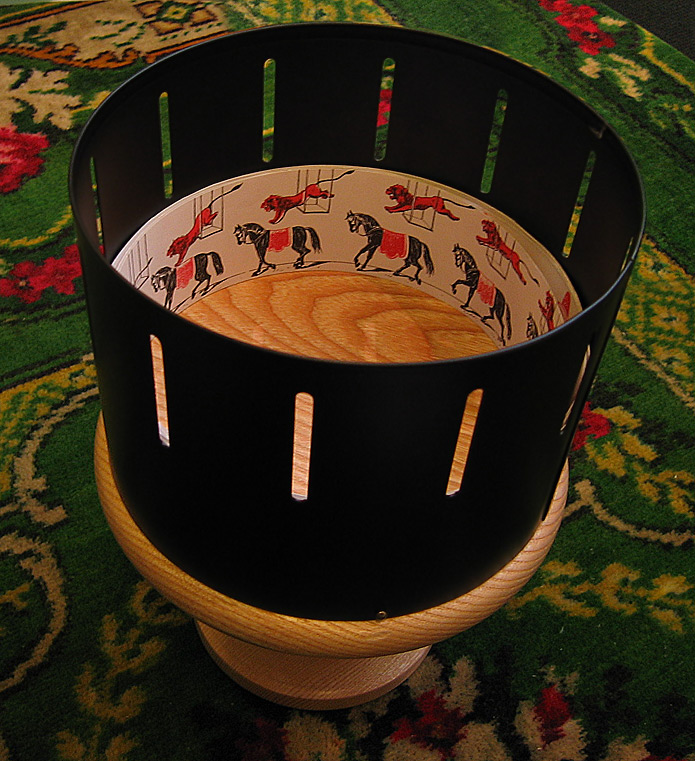
A zoetrope is a device that produces the illusion of motion from a rapid succession of static pictures. The term zoetrope is from the Greek words ζωή (zoe), meaning "alive, active", and τροπή (trope), meaning "turn". "Zoetrope" taken to mean "active turn".
The zoetrope consists of a cylinder with slits cut vertically in the sides. On the inner surface of the cylinder is a band with images from a set of sequenced pictures. As the cylinder spins, the user looks through the slits at the pictures across. The scanning of the slits keeps the pictures from simply blurring together, and the user sees a rapid succession of images, producing the illusion of motion.
Friday, September 26, 2014
Pre-Intuitionists
In some circles of mathematical philosophy, the Pre-Intuitionists are considered to be a small but influential group who informally shared similar philosophies on the nature of mathematics. The term itself was used by L. E. J. Brouwer, who in his 1951 lectures at Cambridge described the differences between intuitionism and its predecessors:
Of a totally different orientation [from the "Old Formalist School" of Dedekind, Cantor, Peano, Hilbert, Russell, Zermelo, and Couturat, etc.] was the Pre-Intuitionist School, mainly led by Poincaré, Borel and Lebesgue. These thinkers seem to have maintained a modified observational standpoint for the introduction of natural numbers, for the principle of complete induction [...] For these, even for such theorems as were deduced by means of classical logic, they postulated an existence and exactness independent of language and logic and regarded its non-contradictority as certain, even without logical proof. For the continuum, however, they seem not to have sought an origin strictly extraneous to language and logic.
Thursday, September 25, 2014
sabaton

A sabaton or solleret is part of a knight's armour that covers the foot. Fifteenth century sabatons typically end in a tapered point well past the actual toes of the wearer's foot. Sabatons of the first half of sixteenth century end at the tip of the toe and may be wider than the actual foot. The first piece of armour to be put on. Made of riveted iron plates.
Princes and dukes were allowed to have toes of gothic sabatons 2.5 feet (0.76 m) long, lords (barons and higher) 2 feet long and gentry only 1-foot (0.30 m) long.
Wednesday, September 24, 2014

Subscribe to:
Posts (Atom)
synanthrope
A synanthrope (from ancient Greek σύν sýn "together, with" and ἄνθρωπος ánthrōpos "man") is an organism that evolve...

-
A canary trap is a method for exposing an information leak by giving different versions of a sensitive document to each of several suspec...
-
A hyperforeignism is a type of qualitative hypercorrection that involves speakers misidentifying the distribution of a pattern found in ...
-
 Nureongi (누렁이) and Hwangu (황구; 黃狗) are Korean terms meaning "Yellow Dog" used to refer to tannish mongrel or landrace of dog in...

