Internetworking is the practice of connecting a computer network with other networks through the use of gateways that provide a common method of routing information packets between the networks. The resulting system of interconnected networks is called an internetwork, or simply an internet. Internetworking is a combination of the words inter ("between") and networking; not internet-working or international-network.
The most notable example of internetworking is the Internet, a network of networks based on many underlying hardware technologies, but unified by an internetworking protocol standard, the Internet Protocol Suite, often also referred to as TCP/IP.
Thursday, October 22, 2015

Wednesday, October 21, 2015
reticle
A reticle, or reticule (from Latin reticulum, meaning "net"), also known as a graticule (from Latin craticula, meaning "gridiron"), is a net of fine lines or fibers in the eyepiece of a sighting device, such as a telescope, a telescopic sight,
a microscope, or the screen of an oscilloscope. Today, engraved lines
or embedded fibers may be replaced by a computer-generated image
superimposed on a screen or eyepiece. Both terms may be used to describe
any set of lines used for optical measurement, but in modern use reticle is most commonly used for gunsights and such, while graticule is more widely used for the covers of oscilloscopes and similar roles.
Tuesday, October 20, 2015
Monday, October 19, 2015
hot and high
In aviation, hot and high is a condition of low air density due to high ambient temperature and high airport elevation. Air density decreases with increasing temperature and altitude. At any given true airspeed, lower air density reduces the amount of lift generated by the wings or the rotors of an aircraft,
which may hamper an aircraft's performance and hence its ability to
operate safely. The reduced density also reduces the performance of the aircraft's engine, compounding the effect. Aviators gauge air density by calculating the density altitude.
"Hot" and "high" do not have to be inclusive of one another, though this tends to be the exception. If an airport is especially hot or high, the other condition need not be present. Temperatures can change from one hour to the next, while the elevation of an airport always remains constant. The fact that temperatures decrease at higher elevations mitigates the "hot and high" effect to a certain extent.
"Hot" and "high" do not have to be inclusive of one another, though this tends to be the exception. If an airport is especially hot or high, the other condition need not be present. Temperatures can change from one hour to the next, while the elevation of an airport always remains constant. The fact that temperatures decrease at higher elevations mitigates the "hot and high" effect to a certain extent.
Sunday, October 18, 2015
Parbuckle salvage
Parbuckle salvage, or parbuckling,
is the righting of a sunken vessel by applying leverage to rotate the
vessel into an upright position from one where it is either on its side
or fully inverted. A common operation with smaller watercraft, parbuckling has been used successfully to right large vessels. In 1943 USS Oklahoma (BB-37) was rotated nearly 180 degrees to upright after being sunk in the attack on Pearl Harbor, TH, and the MS Costa Concordia was successfully parbuckled off the west coast of Italy in the largest salvage operation of that kind to date.
A major concern during salvage is to prevent the rotational torque from becoming a transverse force moving the ship sideways. USS Utah (BB-31), lost like the Oklahoma in the Pearl Harbor attack, was meant to be recovered by a similar rotation after the Oklahoma. As the Utah was rotated, however, its hull did not catch on the harbor bottom, and the vessel slid towards Ford Island. The Utah recovery effort was abandoned.

Shells for 16 inch guns on battleships were stored vertically in the lower part of the gun turret. They weighed about a ton apiece, and were parbuckled to move them sidewise, for both when loaded in port, as well as being moved to the hoist when firing.
A major concern during salvage is to prevent the rotational torque from becoming a transverse force moving the ship sideways. USS Utah (BB-31), lost like the Oklahoma in the Pearl Harbor attack, was meant to be recovered by a similar rotation after the Oklahoma. As the Utah was rotated, however, its hull did not catch on the harbor bottom, and the vessel slid towards Ford Island. The Utah recovery effort was abandoned.
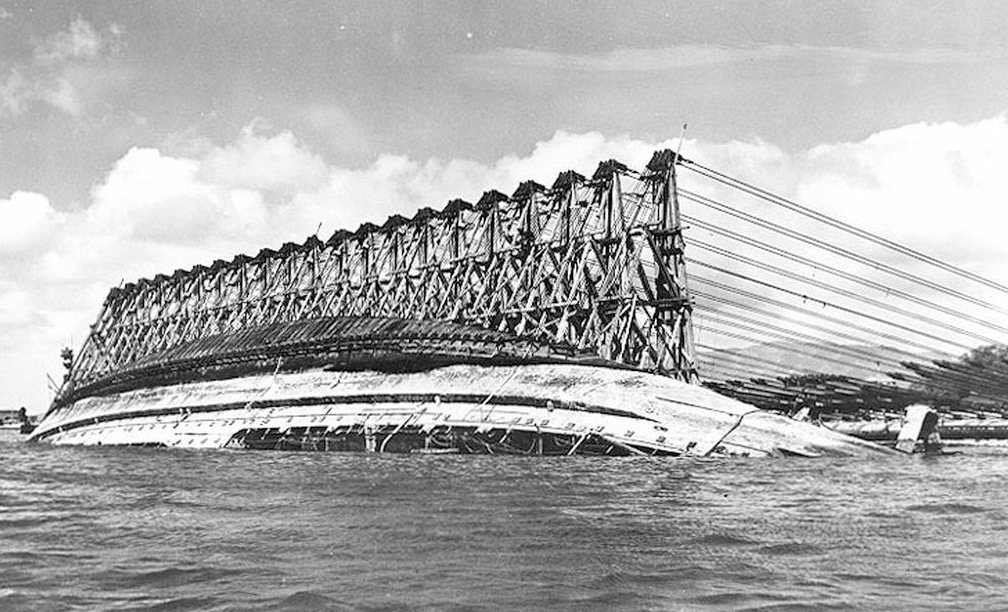
Shells for 16 inch guns on battleships were stored vertically in the lower part of the gun turret. They weighed about a ton apiece, and were parbuckled to move them sidewise, for both when loaded in port, as well as being moved to the hoist when firing.
Saturday, October 17, 2015
John Barleycorn
"John Barleycorn" is a British folksong. The character of John Barleycorn in the song is a personification of the important cereal crop barley and of the alcoholic beverages made from it, beer and whisky.
In the song, John Barleycorn is represented as suffering attacks, death
and indignities that correspond to the various stages of barley
cultivation, such as reaping and malting.
Friday, October 16, 2015
Subscribe to:
Posts (Atom)
synanthrope
A synanthrope (from ancient Greek σύν sýn "together, with" and ἄνθρωπος ánthrōpos "man") is an organism that evolve...

-
A canary trap is a method for exposing an information leak by giving different versions of a sensitive document to each of several suspec...
-
A hyperforeignism is a type of qualitative hypercorrection that involves speakers misidentifying the distribution of a pattern found in ...
-
 Nureongi (누렁이) and Hwangu (황구; 黃狗) are Korean terms meaning "Yellow Dog" used to refer to tannish mongrel or landrace of dog in...

