Wednesday, October 7, 2015

Monday, October 5, 2015

Procrustean

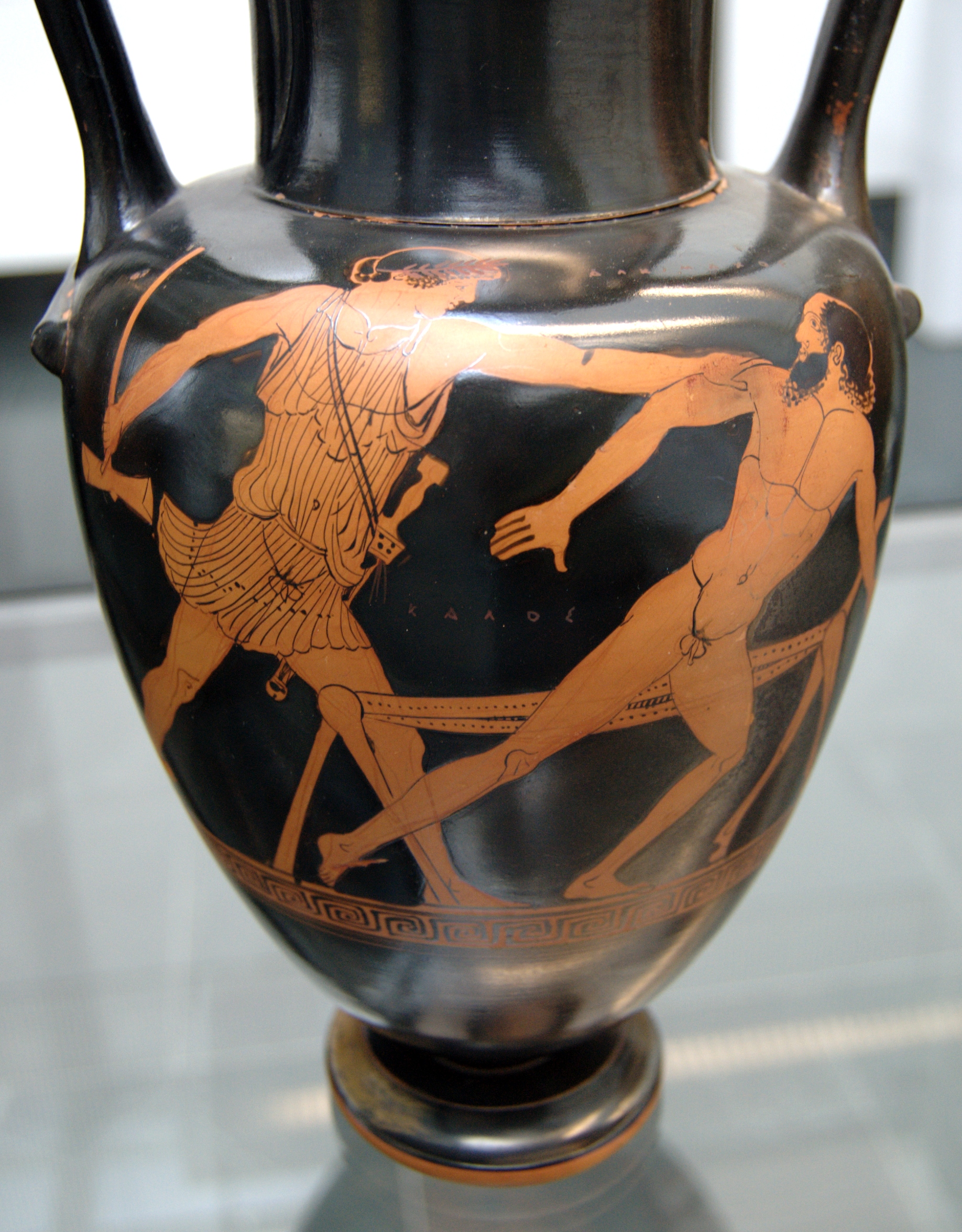
In Greek mythology, Procrustes (Προκρούστης) or "the stretcher [who hammers out the metal]", also known as Prokoptas or Damastes (Δαμαστής) "subduer", was a rogue smith and bandit from Attica who physically attacked people by stretching them or cutting off their legs, so as to force them to fit the size of an iron bed. In general, when something is Procrustean, different lengths or sizes or properties are fitted to an arbitrary standard.

File:Theseus Prokroustes Staatliche Antikensammlungen 2325.jpg

Enforcing strict conformity through disregard of individual differences or special circumstances. [from 17th c.] 

Sunday, October 4, 2015

precariate


In recent years, there has been a growing use in Marxist and Anarchist theory of the concept of "the precariate," to describe a growing reliance on temporary, part-time workers with precarious status, who share aspects of the proletariat and the reserve army of labor.

Although non-employed people who are unable or uninterested in performing legal paid work are not considered among the "unemployed," the concept of conjunctural unemployment is used in economics today (now called "frictional unemployment"). Although Marx's work was earlier, there is no stated link between it and similar modern study.

Saturday, October 3, 2015

pompatus

pompatus
One who is pompous.

Etymology

First used in the lyrics of Steve Miller's 1973 rock song The Joker.

Some people call me the space cowboy.
Yeah! Some call me the gangster of love.
Some people call me Maurice,
'Cause I speak of the pompatus of love.
The phrases "space cowboy", "gangster of love" and "Maurice" are all references to previous Miller songs. The "pompatus" line is also a reference to an earlier song of his, "Enter Maurice", which was recorded the previous year:
My dearest darling, come closer to Maurice
so I can whisper sweet words of epismetology
in your ear and speak to you of the pompatus of love.

Thursday, October 1, 2015

Polysemy

Polysemy (from Greek: πολυ-, poly-, "many" and σῆμα, sêma, "sign") is the capacity for a sign (e.g., a word, phrase, etc.) or signs to have multiple related meanings (sememes), i.e., a large semantic field. It is usually regarded as distinct from homonymy, in which the multiple meanings of a word may be unconnected or unrelated.
Charles Fillmore and Beryl Atkins’ definition stipulates three elements: (i) the various senses of a polysemous word have a central origin, (ii) the links between these senses form a network, and (iii) understanding the ‘inner’ one contributes to understanding of the ‘outer’ one.
Polysemy is a pivotal concept within disciplines such as media studies and linguistics.
synanthrope

 A synanthrope (from ancient Greek σύν sýn "together, with" and ἄνθρωπος ánthrōpos "man") is an organism that evolve...