In computational geometry, a polygonalization of a finite set of points in the Euclidean plane is a simple polygon with the given points as its vertices.

In computational geometry, a polygonalization of a finite set of points in the Euclidean plane is a simple polygon with the given points as its vertices.
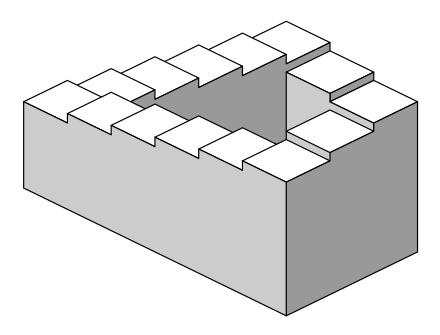
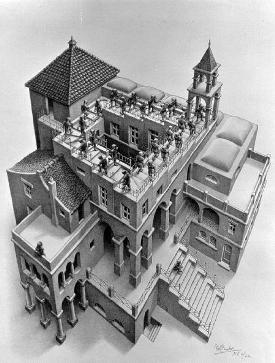
The Penrose stairs or Penrose steps, also dubbed the impossible staircase, is an impossible object created by Oscar Reutersvärd in 1937 and later independently discovered and made popular by Lionel Penrose and his son Roger Penrose. A variation on the Penrose triangle, it is a two-dimensional depiction of a staircase in which the stairs make four 90-degree turns as they ascend or descend yet form a continuous loop, so that a person could climb them forever and never get any higher. This is clearly impossible in three-dimensional Euclidean geometry but possible in some non-eucliean geometry like in nil geometry.
Milü (Chinese: 密率; pinyin: mìlǜ; "close ratio"), also known as Zulü (Zu's ratio), is the name given to an approximation to π (pi) found by Chinese mathematician and astronomer Zu Chongzhi in the 5th century. Using Liu Hui's algorithm (which is based on the areas of regular polygons approximating a circle), Zu famously computed π to be between 3.1415926 and 3.1415927[1] and gave two rational approximations of π, 22/7 and 355/113, naming them respectively Yuelü (Chinese: 约率; pinyin: yuēlǜ; "approximate ratio") and Milü.
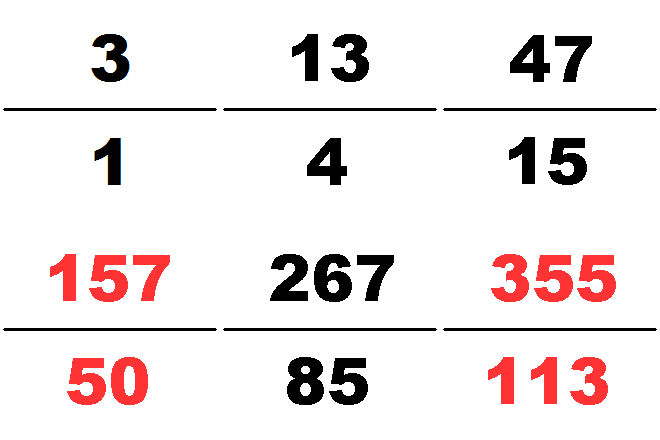
A vinculum (from Latin vinculum 'fetter, chain, tie') is a horizontal line used in mathematical notation for various purposes.
In applied mathematics, discretization is the process of transferring continuous functions, models, variables, and equations into discrete counterparts. This process is usually carried out as a first step toward making them suitable for numerical evaluation and implementation on digital computers. Dichotomization is the special case of discretization in which the number of discrete classes is 2, which can approximate a continuous variable as a binary variable (creating a dichotomy for modeling purposes, as in binary classification).
Discretization is also related to discrete mathematics, and is an important component of granular computing. In this context, discretization may also refer to modification of variable or category granularity, as when multiple discrete variables are aggregated or multiple discrete categories fused.


In the philosophy of mathematics, constructivism asserts that it is necessary to find (or "construct") a mathematical object to prove that it exists. When one assumes that an object does not exist and derives a contradiction from that assumption, one still has not found the object and therefore not proved its existence, according to constructivism. This viewpoint involves a verificational interpretation of the existence quantifier, which is at odds with its classical interpretation.
There are many forms of constructivism. These include the program of intuitionism founded by Brouwer, the finitism of Hilbert and Bernays, the constructive recursive mathematics of Shanin and Markov, and Bishop's program of constructive analysis. Constructivism also includes the study of constructive set theories such as IZF and the study of topos theory.
In some circles of mathematical philosophy, the Pre-Intuitionists are considered to be a small but influential group who informally shared similar philosophies on the nature of mathematics. The term itself was used by L. E. J. Brouwer, who in his 1951 lectures at Cambridge described the differences between intuitionism and its predecessors:
Of a totally different orientation [from the "Old Formalist School" of Dedekind, Cantor, Peano, Hilbert, Russell, Zermelo, and Couturat, etc.] was the Pre-Intuitionist School, mainly led by Poincaré, Borel and Lebesgue. These thinkers seem to have maintained a modified observational standpoint for the introduction of natural numbers, for the principle of complete induction [...] For these, even for such theorems as were deduced by means of classical logic, they postulated an existence and exactness independent of language and logic and regarded its non-contradictority as certain, even without logical proof. For the continuum, however, they seem not to have sought an origin strictly extraneous to language and logic.
Engrams are a hypothetical means by which memory traces are stored as biophysical or biochemical changes in the brain (and other neural tissue) in response to external stimuli.
They are also sometimes thought of as a neural network or fragment of memory, sometimes using a hologram analogy to describe its action in light of results showing that memory appears not to be localized in the brain. The existence of engrams is posited by some scientific theories to explain the persistence of memory and how memories are stored in the brain. The existence of neurologically defined engrams is not significantly disputed, though their exact mechanism and location has been a focus of persistent research for many decades.
In the fields of computational linguistics and probability, an n-gram is a contiguous sequence of n items from a given sequence of text or speech. The items in question can be phonemes, syllables, letters, words or base pairs according to the application. n-grams are collected from a text or speech corpus.
An n-gram of size 1 is referred to as a "unigram"; size 2 is a "bigram" (or, less commonly, a "digram"); size 3 is a "trigram". Larger sizes are sometimes referred to by the value of n, e.g., "four-gram", "five-gram", and so on.
In abstract algebra, sedenions form a 16-dimensional non-associative algebra over the reals obtained by applying the Cayley–Dickson construction to the octonions. The set of sedenions is denoted by  .
.

In geometry, a cuboctahedron is a polyhedron with eight triangular faces and six square faces. A cuboctahedron has 12 identical vertices, with two triangles and two squares meeting at each, and 24 identical edges, each separating a triangle from a square. As such it is a quasiregular polyhedron, i.e. an Archimedean solid, being vertex-transitive and edge-transitive.
Its dual polyhedron is the rhombic dodecahedron.
A synanthrope (from ancient Greek σύν sýn "together, with" and ἄνθρωπος ánthrōpos "man") is an organism that evolve...


