The viewpoint espoused by a Russian fascist
Showing posts with label russia. Show all posts
Showing posts with label russia. Show all posts
Tuesday, March 14, 2023

Sunday, May 22, 2022
Gastarbeiter
Gastarbeiter (lit. German for 'guest worker') are foreign or migrant workers, particularly those who had moved to West Germany between 1955 and 1973, seeking work as part of a formal guest worker program (Gastarbeiterprogramm).
The term is widely used in Russia (Russian: гастарбайтер) to refer to foreign workers from post-USSR or third-world countries.

Wednesday, April 26, 2017
zemstvo
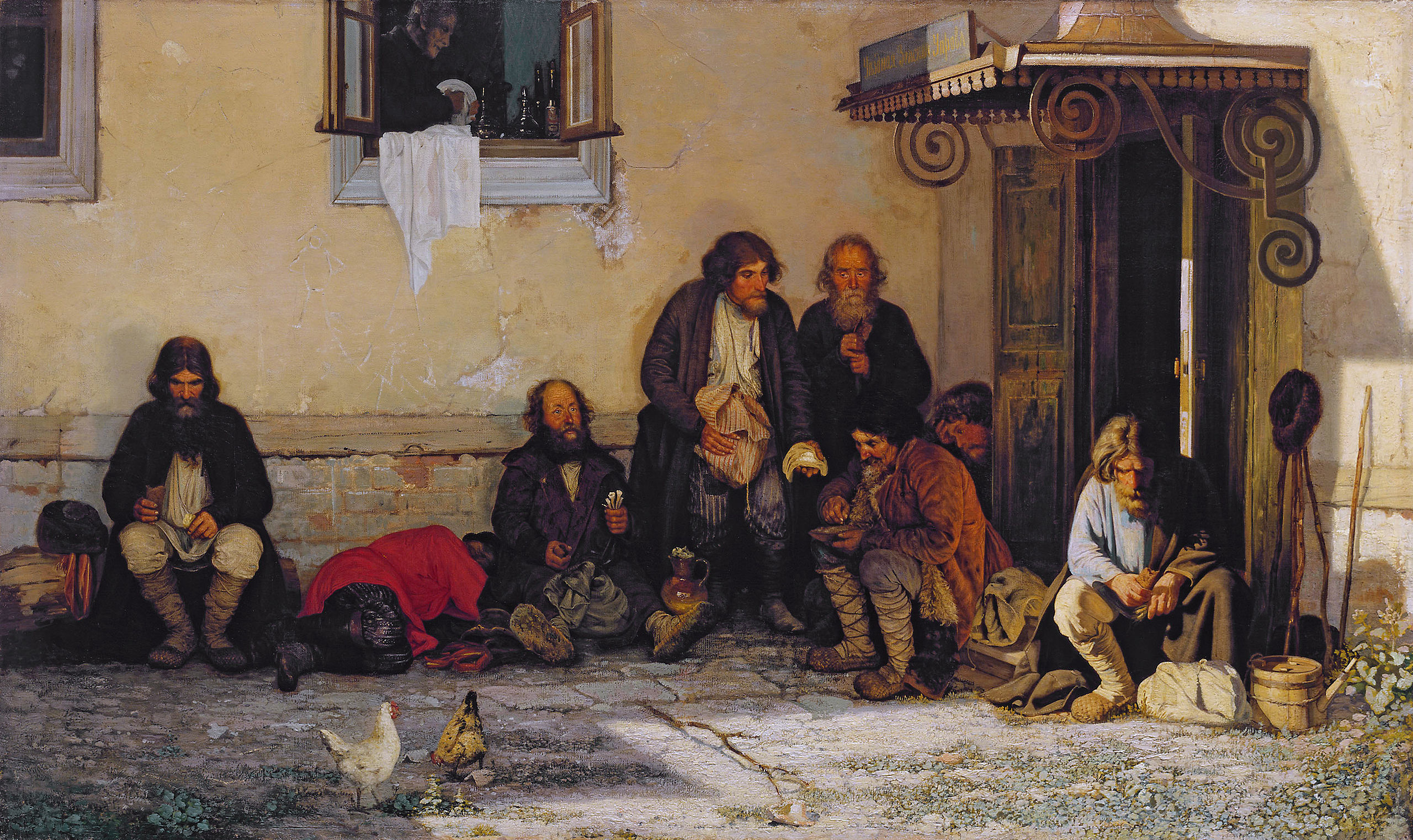
A zemstvo (Russian: земство; IPA: [ˈzʲɛmstvə], plural zemstva - Russian: земства) was an institution of local government set up during the great liberal reforms carried out in Imperial Russia by Emperor Alexander II of Russia (reigned 1855-1881).
Friday, April 24, 2015
Fenya
Fenya (феня) or fenka (фенка) is a Russian cant language used among criminals. Originally it was a cryptolanguage of ofenyas or ofenes, old Russian peddlers, and had a number of names. There are no convincing explanations about the origins of the words "ofenya" and "fenya". In modern Russian language it is also referred to as blatnoy language (Russian: блатной язык), where "blatnoy" is a slang expression for "criminal". It is also widely used in "thieves' songs".
The grammar is Russian; the vocabulary has changed over time.
The original fenya consisted of broken Russian words borrowed from Greek and other foreign languages.Tuesday, October 28, 2014
Setun

Setun (Russian: Сетунь) was a balanced ternary computer developed in 1958 at Moscow State University. The device was built under the lead of Sergei Sobolev and Nikolay Brusentsov. It was the only modern ternary computer, using three-valued ternary logic instead of two-valued binary logic prevalent in computers before and after Setun's conception. The computer was built to fulfill the needs of the Moscow State University and was manufactured at the Kazan Mathematical plant. Fifty computers were built and production was then halted in 1965. In the period between 1965 and 1970, a regular binary computer was then used at Moscow State University to replace it. Although this replacement binary computer performed equally well, it was 2.5 times the cost of the Setun. In 1970, a new ternary computer, the Setun-70, was designed. The computer was named after the Setun River, which ends near Moscow University.
Wednesday, September 3, 2014
Doukhobor
The Doukhobors or Dukhobors (Russian: Духоборы, Dukhobory), earlier Dukhobortsy (Russian: Духоборцы) (literally - Spirit-Wrestlers) are a group of Russian origin. The Doukhobors were one of the sects - later defined as a religious philosophy, ethnic group, social movement, or simply a "way of life" - known generically as Spiritual Christianity. The origin of the Doukhobors is uncertain. The first clear record of their existence, and the first use of the names related to "Doukhobors", are from the 18th century. However, some scholars believe that the sect had its origins in the 17th or even the 16th century. They rejected secular government, the Russian Orthodox priests, icons, all church ritual, the Bible as the supreme source of divine revelation, and the divinity of Jesus. Their pacifist beliefs and desire to avoid government interference in their life led to an exodus of the majority of the group from the Russian Empire to Canada at the close of the 19th century.
Thursday, July 31, 2014
Samizdat
Samizdat (Russian: самиздат; Russian pronunciation: [səmʲɪzˈdat]) was a key form of dissident activity across the Soviet bloc in which individuals reproduced censored publications by hand and passed the documents from reader to reader. This grassroots practice to evade officially imposed censorship was fraught with danger as harsh punishments were meted out to people caught possessing or copying censored materials.
Tuesday, February 11, 2014
Interkosmos
Interkosmos (Russian: ИнтерКосмос) was a space program of the Soviet Union designed to include members of military forces of allied Warsaw Pact countries in manned and unmanned missions. The participation of countries which were not Soviet allies, such as India, Syria and France was a reflection of non-aligned politics during the Cold War.
Begun in April 1967 with unmanned research satellite missions, the first manned mission occurred in February 1978. Interkosmos missions enabled 14 non-Soviet cosmonauts to participate in Soyuz space flights between 1978 and 1988. The program was responsible for sending into space the first citizen of a country other than the USA or USSR; Vladimír Remek of Czechoslovakia. Interkosmos also resulted in the first black and Hispanic person in space, Arnaldo Tamayo Méndez of Cuba, and the first Asian person in space, Phạm Tuân of Vietnam. Of the countries involved, only Bulgaria sent two cosmonauts in space.
Tuesday, September 17, 2013
zither

The zither is a musical string instrument, most commonly found in Slovenia, Austria, Hungary citera, northwestern Croatia, the southern regions of Germany, alpine Europe and East Asian cultures, including China. The term "citre" is also used more broadly, to describe the entire family of stringed instruments in which the strings do not extend beyond the sounding box, including the hammered dulcimer, psaltery, Appalachian dulcimer, guqin, guzheng (Chinese zither), koto, gusli, kantele, gayageum, đàn tranh, kanun, autoharp, santoor, yangqin, piano, harpsichord, santur, swarmandal, and others. Modern electric zithers exist, as well as a wide variation of experimental zithers like the Kitaras of Harry Partch, the Shruti Stick and the Moodswinger. It is played by strumming or plucking the strings like a guitar.
Sunday, December 16, 2012
Lunokhod

Lunokhod was a series of Soviet robotic lunar rovers designed to land on the Moon between 1969 and 1977. The 1969 Lunokhod 1A was destroyed during launch, the 1970 Lunokhod 1 and the 1973 Lunokhod 2 landed on the moon and the 1977 Lunokhod was never launched. The successful missions were in operation concurrently with the Zond and Luna series of Moon flyby, orbiter and landing missions. The Lunokhods were primarily designed to support the Soviet manned moon missions and to be used as automatic remote-controlled robots to explore the surface and return pictures. The Lunokhods were transported to the lunar surface by Luna spacecraft, which were launched by Proton rockets. The moon lander part of the Luna spacecraft for Lunokhods were similar to the ones for sample return missions. The Lunokhods were designed by Alexander Kemurdjian at NPO Lavochkin. Not until the 1997 Mars Pathfinder was another remote-controlled vehicle put on an extraterrestrial body. In 2010, nearly forty years after the 1971 loss of signal from Lunokhod 1, the NASA Lunar Reconnaissance Orbiter photographed its tracks and final location, and researchers, using a telescopic pulsed-laser rangefinder, detected the robot's retroreflector.
Monday, November 19, 2012
kremlin

A kremlin is a major fortified central complex found in historic Russian cities. This word is often used to refer to the best-known one, the Moscow Kremlin, or metonymically to the government that is based there. Outside Russia, the name Kremlin is sometimes mistakenly thought of as being Saint Basil's Cathedral because of its distinctive environment, although this is not a part of the Moscow Kremlin.
The name Kremlin (or Kreml) has been allocated to various Soviet Navy vessels during construction. In each case, the name was changed prior to commissioning. Vessels which have briefly carried this name included Admiral Kuznetsov and Ulyanovsk.
Russia's presidential administration is located in the Moscow Kremlin. During the Soviet era, the government of the USSR was located in that kremlin, but now the Russian government occupies a building outside it.
Friday, July 27, 2012
Spetsnaz

Russian Special Purpose Forces or Spetsnaz, Specnaz is an umbrella term for any "special forces" in Russian, literally "force of special purpose". These Russian special forces can specifically refer to any elite or special purpose units under subordination of the Federal Security Service (FSB) or Internal Troops of Russian Ministry of Internal Affairs, and the units controlled by the military intelligence service GRU.
Friday, May 11, 2012
Stakhanovite

In Soviet history and iconography, a Stakhanovite (стахановец) follows the example of Aleksei Grigorievich Stakhanov, employing hard work or Taylorist efficiencies to over-achieve on the job.
The Stakhanovite movement began during the second 5-year plan in 1935 as a new stage of the socialist competition. The Stakhanovite movement was named after Aleksei Stakhanov, who had mined 102 tons of coal in less than 6 hours (14 times his quota).
Saturday, January 30, 2010
Qualimetry
Qualimetry is a scientific theory of the quantitative determination of quality developed in the former USSR by G.G.Azgal'dov and currently used in development of Russian standards.
Sunday, January 17, 2010
ekranoplan

An ekranoplan (Russian: экранопла́н, French: ecran screen + plan plane ) is a vehicle resembling an aircraft but which operates solely on the principle of ground effect (in Russian эффект экрана effekt ekrana - from which the name derived). Ground effect vehicles fly above any flat surface, with the height above ground dependent upon the size of the vehicle. Ekranoplan design was conceived by revolutionary Soviet engineer Rostislav Alexeev.
Sunday, October 25, 2009
Tuesday, September 22, 2009
Trotskyism

Trotskyism is the theory of Marxism as advocated by Leon Trotsky. Trotsky considered himself an orthodox Marxist and Bolshevik-Leninist, arguing for the establishment of a vanguard party. His politics differed sharply from Stalinism, most importantly in declaring the need for an international proletarian revolution, rather than socialism in one country, and unwavering support for a true dictatorship of the proletariat based on democratic principles.
Trotsky's followers maintain that, together with Lenin, Trotsky was the most important leader of the Russian Revolution and the international Communist movement in 1917 and the following years. Nowadays, numerous groups around the world continue to describe themselves as Trotskyist, although they have developed Trotsky's ideas in different ways. A follower of Trotskyist ideas is usually called a "Trotskyist" or (in an informal or pejorative way) a "Trotskyite" or "Trot".Saturday, December 13, 2008
nomenklatura
The nomenklatura were a small, elite subset of the general population in the Soviet Union and other Eastern Bloc countries who held various key administrative positions in all spheres of those countries' activity: government, industry, agriculture, education, etc. The nomenklatura was analogous to the ruling class, which Communist doctrine denounced in the capitalist West.
Subscribe to:
Posts (Atom)
synanthrope
A synanthrope (from ancient Greek σύν sýn "together, with" and ἄνθρωπος ánthrōpos "man") is an organism that evolve...

-
A canary trap is a method for exposing an information leak by giving different versions of a sensitive document to each of several suspec...
-
A hyperforeignism is a type of qualitative hypercorrection that involves speakers misidentifying the distribution of a pattern found in ...
-
 Nureongi (누렁이) and Hwangu (황구; 黃狗) are Korean terms meaning "Yellow Dog" used to refer to tannish mongrel or landrace of dog in...

