A comfort object, more formally a transitional object or attachment object, is an item used to provide psychological comfort, especially in unusual or unique situations, or at bedtime for children. Among toddlers, a comfort object often takes the form of a blanket (called a security blanket) or a stuffed animal, doll or other toy, and may be referred to by a nickname such as blankie.
Saturday, October 7, 2023
Friday, August 18, 2023
Mand
Mand is a term that B.F. Skinner used to describe a verbal operant in which the response is reinforced by a characteristic consequence and is therefore under the functional control of relevant conditions of deprivation or aversive stimulation. One cannot determine, based on form alone, whether a response is a mand; it is necessary to know the kinds of variables controlling a response in order to identify a verbal operant. A mand is sometimes said to "specify its reinforcement" although this is not always the case. Skinner introduced the mand as one of six primary verbal operants in his 1957 work, Verbal Behavior.
Chapter three of Skinner's work, Verbal Behavior, discusses a functional relationship called the mand. A mand is a form of verbal behavior that is controlled by deprivation, satiation, or what is now called motivating operations (MO), as well as a controlling history. An example of this would be asking for water when one is water deprived ("thirsty"). It is tempting to say that a mand describes its reinforcer, which it sometimes does. But many mands have no correspondence to the reinforcer. For example, a loud knock may be a mand "open the door" and a servant may be called by a hand clap as much as a child might "ask for milk."
Saturday, January 28, 2023
Sunday, April 24, 2022
nyctophilia
nyctophilia
- n. a strong preference for darkness or night. Also called noctiphilia; noctophilia; scotophilia.
Saturday, February 26, 2022
Monday, February 21, 2022
Saturday, January 29, 2022
Reactance
Reactance is an unpleasant motivational arousal (reaction) to offers, persons, rules, or regulations that threaten or eliminate specific behavioral freedoms. Reactance occurs when a person feels that someone or something is taking away their choices or limiting the range of alternatives.
Reactance can occur when someone is heavily pressured to accept a certain view or attitude. Reactance can cause the person to adopt or strengthen a view or attitude that is contrary to what was intended, and also increases resistance to persuasion. People using reverse psychology are playing on reactance, attempting to influence someone to choose the opposite of what they request.
Some individuals are naturally high in reactance, a personality characteristic called trait reactance.
Monday, April 12, 2021
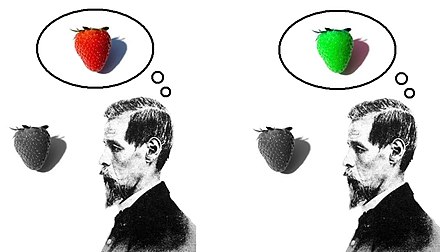
qualia
In philosophy and certain models of psychology, qualia (/ˈkwɑːliə/ or /ˈkweɪliə/; singular form: quale) are defined as individual instances of subjective, conscious experience.
Thursday, April 8, 2021
Perseveration
Perseveration according to psychology, psychiatry, and speech-language pathology, is the repetition of a particular response (such as a word, phrase, or gesture) regardless of the absence or cessation of a stimulus. It is usually caused by a brain injury or other organic disorder. Symptoms include "lacking ability to transition or switch ideas appropriately with the social context, as evidenced by the repetition of words or gestures after they have ceased to be socially relevant or appropriate", or the "act or task of doing so", and are not better described as stereotypy (a highly repetitive idiosyncratic behaviour).
Saturday, November 21, 2015
trust metric
Trust escapes a simple measurement because its meaning is too subjective for universally reliable metrics, and the fact that it is a mental process, unavailable to instruments. There is a strong argument against the use of simplistic metrics to measure trust due to the complexity of the process and the 'embeddedness' of trust that makes it impossible to isolate trust from related factors. For a detailed discussion about different trust metrics see.
Sunday, July 20, 2014
Prosocial behavior
Saturday, July 19, 2014
Hawthorne effect
The Hawthorne effect is a form of reactivity whereby subjects improve or modify an aspect of their behavior being experimentally measured simply in response to the fact that they know they are being studied, not in response to any particular experimental manipulation.
The term was coined in 1950 by Henry A. Landsberger when analysing older experiments from 1924-1932 at the Hawthorne Works (a Western Electric factory outside Chicago). Hawthorne Works had commissioned a study to see if its workers would become more productive in higher or lower levels of light. The workers' productivity seemed to improve when changes were made and slumped when the study was concluded. It was suggested that the productivity gain occurred due to the impact of the motivational effect on the workers as a result of the interest being shown in them. Although illumination research of workplace lighting formed the basis of the Hawthorne effect, other changes such as maintaining clean work stations, clearing floors of obstacles, and even relocating workstations resulted in increased productivity for short periods. Thus the term is used to identify any type of short-lived increase in productivity.Sunday, December 8, 2013
Coulrophobia
Wednesday, October 17, 2012
Self-efficacy
Self-efficacy is a term used in psychology, roughly corresponding to a person's belief in their own competence.
It has been defined as the belief that one is capable of performing in a certain manner to attain certain goals. Eduology focuses on factors that create a meaning for individuals. It is believed that our personalized ideas of self-efficacy affect our social interactions in almost every way. Understanding how to foster the development of self-efficacy is a vitally important goal for positive psychology because it can lead to living a more productive and happy life.
Sunday, January 2, 2011
Persuasion
Friday, December 17, 2010
Sunday, November 14, 2010
Bradyphrenia
Friday, November 12, 2010
Erotomania
Erotomania is a type of delusion in which one believes that another person is in love with onesself. The illness often occurs during psychosis, especially in patients with schizophrenia or bipolar mania. In one case, erotomania was reported in a patient who had undergone surgery for a ruptured cerebral aneurysm. During an erotomanic psychosis, the patient believes that a "secret admirer" is declaring his or her affection to the patient, often by special glances, signals, telepathy, or messages through the media. Usually the patient then returns the perceived affection by means of letters, phone calls, gifts, and visits to the confused recipient.
Tuesday, October 5, 2010
Cryptomnesia
Friday, October 1, 2010
synanthrope
A synanthrope (from ancient Greek σύν sýn "together, with" and ἄνθρωπος ánthrōpos "man") is an organism that evolve...
-
A canary trap is a method for exposing an information leak by giving different versions of a sensitive document to each of several suspec...
-
A synanthrope (from ancient Greek σύν sýn "together, with" and ἄνθρωπος ánthrōpos "man") is an organism that evolve...
-
A kouros (plural kouroi , Ancient Greek κοῦρος ) is the modern term given to those representations of male youths which first appear i...