(a) One who scatters seed on the ground for growth; also fig.; (b) one who causes strife; also, a creator; ~ of discorde(s; ~ of wordes, a babbler
Showing posts with label work. Show all posts
Showing posts with label work. Show all posts
Tuesday, November 14, 2023
souer

Wednesday, August 30, 2023
sedulous
sedulous adj
- Of a person: diligent in application or pursuit; constant and persevering in business or in endeavours to effect a goal; steadily industrious.
- Of an activity: carried out with diligence.
Friday, December 9, 2022
Sunday, September 25, 2022
Tuesday, April 13, 2021
dogsbody
A dogsbody, dog's body, or less commonly dog robber is someone who does menial or drudge work. Originally, in the British Royal Navy, a dogsbody was a semi-sarcastic colloquialism for a junior officer or midshipman.
A rough American equivalent would be a package-handler, gofer, grunt, or lackey.
Sunday, October 4, 2015
precariate
In recent years, there has been a growing use in Marxist and Anarchist theory of the concept of "the precariate," to describe a growing reliance on temporary, part-time workers with precarious status, who share aspects of the proletariat and the reserve army of labor.
Although non-employed people who are unable or uninterested in performing legal paid work are not considered among the "unemployed," the concept of conjunctural unemployment is used in economics today (now called "frictional unemployment"). Although Marx's work was earlier, there is no stated link between it and similar modern study.
Thursday, August 27, 2015
Flextime
Flextime (also spelled flexitime [British English], flexi-time) is a variable work schedule, in contrast to traditional work arrangements requiring employees to work a standard 9 a.m. to 5 p.m. day.
Under flextime, there is typically a core period (of approximately 50%
of total working time / working day) of the day, when employees are
expected to be at work (for example, between 11 a.m. and 3 p.m.), while
the rest of the working day is "flextime", in which employees can choose
when they work, subject to achieving total daily, weekly or monthly
hours in the region of what the employer expects, and subject to the
necessary work being done. A flextime policy allows staff to determine
when they will work, while a flexplace
policy allows staff to determine where they will work. Advantages
include allowing employees to adopt their work hours to public transport
schedules, to the schedules their children have, and that road traffic
will be less congested, more spread out.
Wednesday, July 22, 2015
Navvy
Navvy is a shorter form of navigator (UK) or navigational engineer (USA) and is particularly applied to describe the manual labourers working on major civil engineering projects. The term was coined in the late 18th century in Britain when numerous canals were being built, which were also sometimes known as "navigations", or "eternal navigations", intended to last forever.

Monday, July 20, 2015
Stevedore
Stevedore, dockworker, docker, dock labourer, wharfie and longshoreman can have various waterfront-related meanings concerning loading and unloading ships, according to place and country.
The word stevedore originated in Portugal or Spain, and entered the English language through its use by sailors. It started as a phonetic spelling of estivador (Portuguese) or estibador (Spanish), meaning a man who stuffs, here in the sense of a man who loads ships, which was the original meaning of stevedore; compare Latin stīpāre meaning to stuff, as in to fill with stuffing. In the United Kingdom, men who load and unload ships are usually called dockers, in Australia wharfies, while in the United States and Canada the term longshoreman, derived from man-along-the-shore, is used. Before extensive use of container ships and shore-based handling machinery in the U.S., longshoremen referred exclusively to the dockworkers, while stevedores, in a separate trade union, worked on the ships, operating ship's cranes and moving cargo. In Canada, the term stevedore has also been used, for example, in the name of the Western Stevedoring Company, Ltd., based in Vancouver, B.C. in the 1950s.
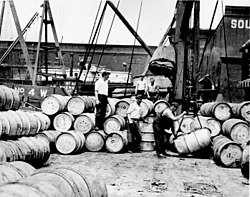
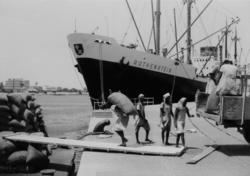
The word stevedore originated in Portugal or Spain, and entered the English language through its use by sailors. It started as a phonetic spelling of estivador (Portuguese) or estibador (Spanish), meaning a man who stuffs, here in the sense of a man who loads ships, which was the original meaning of stevedore; compare Latin stīpāre meaning to stuff, as in to fill with stuffing. In the United Kingdom, men who load and unload ships are usually called dockers, in Australia wharfies, while in the United States and Canada the term longshoreman, derived from man-along-the-shore, is used. Before extensive use of container ships and shore-based handling machinery in the U.S., longshoremen referred exclusively to the dockworkers, while stevedores, in a separate trade union, worked on the ships, operating ship's cranes and moving cargo. In Canada, the term stevedore has also been used, for example, in the name of the Western Stevedoring Company, Ltd., based in Vancouver, B.C. in the 1950s.
Thursday, February 23, 2012
equerry
An equerry (from French: "écurie" (stable), and related to the French word "écuyer" (squire)) is an officer of honour. Historically, it was a senior attendant with responsibilities for the horses of a person of rank. In contemporary use, it is a personal attendant, usually upon a Sovereign, a member of a Royal Family, or a national representative. They are equivalent to Aides-de-Camp, but the term is specific to the Commonwealth of Nations.
Tuesday, April 12, 2011
Karōshi
Karōshi (過労死 karōshi), which can be translated literally from Japanese as "death from overwork", is occupational sudden death. Although this category has a significant count, Japan is one of the few countries that reports it in the statistics as a separate category. The major medical causes of karōshi deaths are heart attack and stroke due to stress.
Tuesday, October 5, 2010
Cryptomnesia
Cryptomnesia, or inadvertent plagiarism, is a memory bias whereby a person falsely recalls generating a thought, an idea, a song, or a joke, when the thought was actually generated by someone else. In these cases, the person is not deliberately engaging in plagiarism, but is rather experiencing a memory as if it were a new inspiration.

Saturday, August 7, 2010

Monday, August 18, 2008
Subscribe to:
Posts (Atom)
synanthrope
A synanthrope (from ancient Greek σύν sýn "together, with" and ἄνθρωπος ánthrōpos "man") is an organism that evolve...

-
A canary trap is a method for exposing an information leak by giving different versions of a sensitive document to each of several suspec...
-
A synanthrope (from ancient Greek σύν sýn "together, with" and ἄνθρωπος ánthrōpos "man") is an organism that evolve...
-
 A kouros (plural kouroi , Ancient Greek κοῦρος ) is the modern term given to those representations of male youths which first appear i...

