Showing posts with label geology. Show all posts

Monday, March 20, 2023

K–Pg boundary

 The Cretaceous–Paleogene (K–Pg) boundary, formerly known as the Cretaceous–Tertiary (K–T) boundary, is a geological signature, usually a thin band of rock containing much more iridium than other bands. The K–Pg boundary marks the end of the Cretaceous Period, the last period of the Mesozoic Era, and marks the beginning of the Paleogene Period, the first period of the Cenozoic Era. Its age is usually estimated at around 66 million years, with radiometric dating yielding a more precise age of 66.043 ± 0.011 Ma.


Saturday, February 11, 2023

bifurcation lake

 A bifurcation lake is a lake that has outflows into two different drainage basins and thus the drainage divide cannot be defined exactly because it is situated in the middle of the lake. 


Peeler Lake in California's Hoover Wilderness is a natural bifurcated lake that lies along the Great Basin Divide. It has two outlets, one of which drains east into the Great Basin, and one of which drains west to the Pacific Ocean.

Thursday, November 3, 2022

Rhyolite

 Rhyolite (/ˈr.əlt/ RY-ə-lyte) is the most silica-rich of volcanic rocks. It is generally glassy or fine-grained (aphanitic) in texture, but may be porphyritic, containing larger mineral crystals (phenocrysts) in an otherwise fine-grained groundmass. The mineral assemblage is predominantly quartz, sanidine, and plagioclase. It is the extrusive equivalent to granite.


Thursday, May 26, 2022

Cinnabar

 Cinnabar (/ˈsɪnəˌbɑːr/) or cinnabarite (/sɪnəˈbɑːrt/), from the Ancient Greek: κιννάβαρι (kinnabari), is the bright scarlet to brick-red form of mercury(II) sulfide (HgS). It is the most common source ore for refining elemental mercury, and is the historic source for the brilliant red or scarlet pigment termed vermilion and associated red mercury pigments


Thursday, April 28, 2022

chronozone

 A chronozone or chron is a unit in chronostratigraphy, defined by events such as geomagnetic reversals (magnetozones), or based on the presence of specific fossils (biozone or biochronozone). According to the International Commission on Stratigraphy, the term "chronozone" refers to the rocks formed during a particular time period, while "chron" refers to that time period.


Wednesday, April 27, 2022

Biostratigraphy

 Biostratigraphy is the branch of stratigraphy which focuses on correlating and assigning relative ages of rock strata by using the fossil assemblages contained within them.


Tuesday, April 26, 2022

Monday, April 11, 2022

Downland

 Downland, chalkland, chalk downs or just downs are areas of open chalk hills, such as the North Downs. This term is used to describe the characteristic landscape in southern England where chalk is exposed at the surface. The name "downs" is derived from the Old English word dun, meaning "hill".


Saturday, April 9, 2022

chine


A chine ( /ˈn/) is a steep-sided coastal gorge where a river flows to the sea through, typically, soft eroding cliffs of sandstone or clays. The word is still in use in central Southern England—notably in East Devon, Dorset, Hampshire and the Isle of Wight—to describe such topographical features. The term 'bunny' is sometimes used to describe a chine in Hampshire. The term chine is also used in some Vancouver suburbs in Canada to describe similar features.


Saturday, September 11, 2021

Orogeny

 Orogeny is the primary mechanism by which mountains are formed on continents. An orogeny is an event that takes place at a convergent plate margin when plate motion compresses the margin. 


Thursday, July 26, 2018

Mass wasting

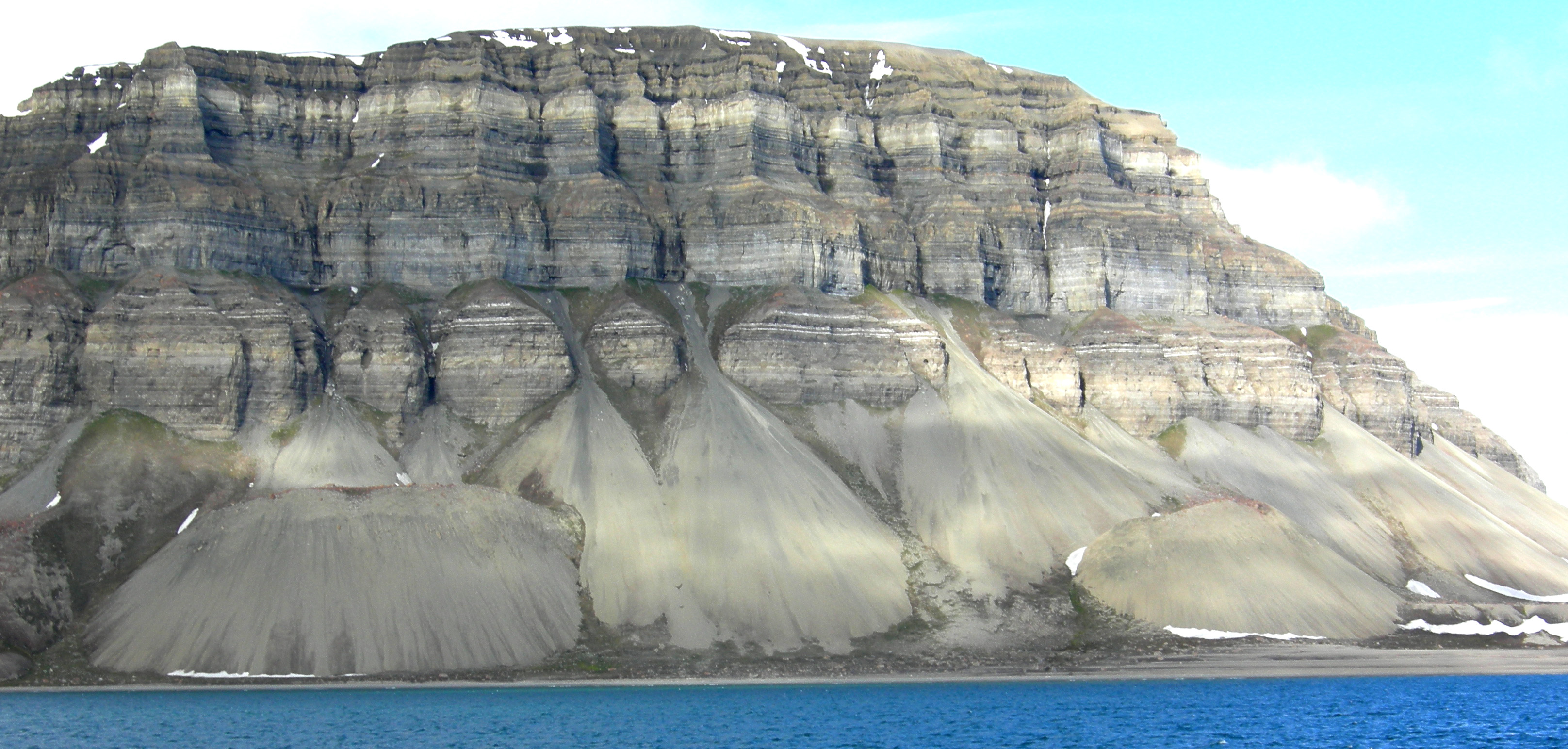
Mass wasting, also known as slope movement or mass movement, is the geomorphic process by which soil, sand, regolith, and rock move downslope typically as a solid, continuous or discontinuous mass, largely under the force of gravity, but frequently with characteristics of a flow as in debris flows and mudflows. Types of mass wasting include creep, slides, flows, topples, and falls, each with its own characteristic features, and taking place over timescales from seconds to hundreds of years. Mass wasting occurs on both terrestrial and submarine slopes, and has been observed on Earth, Mars, Venus, and Jupiter's moon Io.


When the gravitational force acting on a slope exceeds its resisting force, slope failure (mass wasting) occurs. The slope material's strength and cohesion and the amount of internal friction between material help maintain the slope's stability and are known collectively as the slope's shear strength. The steepest angle that a cohesionless slope can maintain without losing its stability is known as its angle of repose. When a slope made of loose material possesses this angle, its shear strength perfectly counterbalances the force of gravity acting upon it.
Sunday, February 7, 2016

skerry


A skerry is a small rocky island, usually defined to be too small for habitation; it may simply be a rocky reef. A skerry can also be called a low sea stack.
The term skerry is derived from the Old Norse sker, which means a rock in the sea. The Old Norse term sker was brought into the English language via the Scots language word spelled skerrie or skerry. It is a cognate of the Scandinavian languages' words for skerryIcelandic, Faroese: sker, Danish: skær, Swedish: skär, Norwegian: skjær / skjer, found also in German: Schäre, Finnish "kari", Estonian: skäär, Latvian: šēra and Russian: шхеры (shkhery). In Scottish Gaelic, it appears as sgeir, e.g. Sula Sgeir, in Irish as sceir, and in Manx as skeyr. The word is also probably related to the Italian word scoglio, sharing the same meaning.

Saturday, February 6, 2016

Bottlebrush

Bottlebrushes are an uncommon cave formation which result from a rise in water level such that the stalactites become immersed. If the water is supersaturated with calcium carbonate the stalactite will become coated with pool spar.

Tuesday, July 21, 2015

Stratigraphy

Stratigraphy is a branch of geology which studies rock layers and layering (stratification). It is primarily used in the study of sedimentary and layered volcanic rocks. Stratigraphy includes two related subfields: lithologic stratigraphy or lithostratigraphy, and biologic stratigraphy or biostratigraphy.

File:Quebrada de Cafayate, Salta (Argentina).jpg

Sunday, January 11, 2015

Novopangea

Novopangea is a possible future supercontinent, postulated by Roy Livermore, now at the University of Cambridge, in the late 1990s, assuming closure of the Pacific, docking of Australia with eastern Asia, and northward motion of Antarctica.

The development of the three hypothetical supercontinents: Amasia, Novopangea, and Pangaea Ultima, were illustrated in a 2007 New Scientist article.

Friday, January 9, 2015

Amasia

Amasia is the working title for a possible future supercontinent that could be formed by the merger of Asia and North America. This prediction relies mostly on the fact that the Pacific Plate is already subducting under Eurasia and North America, a process which if continued will eventually cause the Pacific to close. Meanwhile, because of the Atlantic mid-ocean ridge, North America would be pushed westward. Thus, the Atlantic at some point in the future would be larger than the Pacific. In Siberia, the boundary between the Eurasian and North American Plates has been stationary for millions of years. The combination of these factors would cause North America to be combined with Asia, thus forming a supercontinent.

Sunday, June 1, 2014

Aalenian

The Aalenian is a subdivision of the Middle Jurassic epoch/series of the geologic timescale that extends from about 175.6 Ma to about 171.6 Ma (million years ago). It was preceded by the Toarcian and succeeded by the Bajocian.

Thursday, April 17, 2014

supervolcano

A supervolcano is a volcano capable of producing a volcanic eruption with an ejecta volume greater than 1,000 cubic kilometers (240 cubic miles). This is thousands of times larger than most historic volcanic eruptions. Supervolcanoes can occur when magma in the Earth rises into the crust from a hotspot but is unable to break through the crust. Pressure builds in a large and growing magma pool until the crust is unable to contain the pressure. They can also form at convergent plate boundaries (for example, Toba) and continental hotspot locations (for example, Yellowstone).

Thursday, April 3, 2014

Ferropericlase

Ferropericlase or Magnesiowüstite is a magnesium/iron oxide ((Mg,Fe)O) that is interpreted to be one of the main constituents of the Earth's lower mantle together with a magnesium /iron silicate with a perovskite structure. Ferropericlase has been found as inclusions in a few natural diamonds. An unusually high iron content in one suite of diamonds has been associated with an origin from the lowermost mantle.

Sunday, February 16, 2014

diagenesis

In geology and oceanography, diagenesis is any chemical, physical, or biological change undergone by a sediment after its initial deposition and during and after its lithification, exclusive of surface alteration (weathering) and metamorphism. These changes happen at relatively low temperatures and pressures and result in changes to the rock's original mineralogy and texture. There is no sharp boundary between diagenesis and metamorphism, but the latter occurs at higher temperature and pressure than the former.

After deposition, sediments are compacted as they are buried beneath successive layers of sediment and cemented by minerals that precipitate from solution. Grains of sediment, rock fragments and fossils can be replaced by other minerals during diagenesis. Porosity usually decreases during diagenesis, except in rare cases such as dissolution of minerals and dolomitization.

The study of diagenesis in rocks is used to understand the tectonic history they have undergone; the nature and type of fluids that have circulated through them. From a commercial standpoint, such studies aid in assessing the likelihood of finding various economically viable mineral and hydrocarbon deposits.

synanthrope

 A synanthrope (from ancient Greek σύν sýn "together, with" and ἄνθρωπος ánthrōpos "man") is an organism that evolve...