Showing posts with label economics. Show all posts

Thursday, September 22, 2022

rivalrous

 n economics, a good is said to be rivalrous or a rival if its consumption by one consumer prevents simultaneous consumption by other consumers, or if consumption by one party reduces the ability of another party to consume it. A good is considered non-rivalrous or non-rival if, for any level of production, the cost of providing it to a marginal (additional) individual is zero. A good is "anti-rivalrous" and "inclusive" if each person benefits more when other people consume it. 


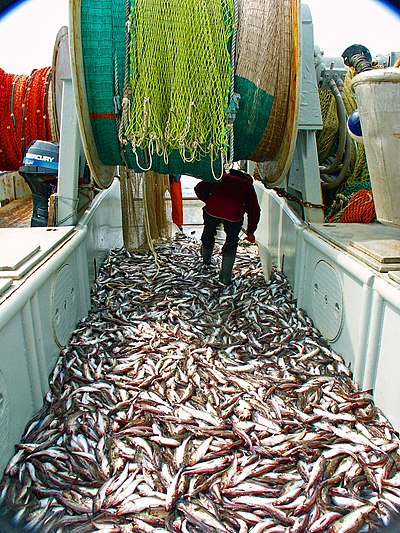
 Wild fish stocks are a rivalrous good, as the amount of fish caught by one boat reduces the number of fish available to be caught by others.

Wednesday, June 1, 2022

Thursday, January 20, 2022

exogeny

In a variety of contexts, exogeny or exogeneity (from Greek ἔξω éxō 'outside' and -γένεια -géneia 'to produce') is the fact of an action or object originating externally. It contrasts with endogeneity or endogeny, the fact of being influenced within a system.

Monday, August 3, 2015

Lumpenproletariat

Lumpenproletariat is a term that was originally coined by Karl Marx to describe that layer of the working class that is unlikely to ever achieve class consciousness and is therefore lost to socially useful production, of no use to the revolutionary struggle, and may actually be an impediment to the realization of a classless society. The word is derived from the German word Lumpenproletarier, a word literally meaning "miscreant" as well as "rag". The term proletarian was first defined by Marx and Friedrich Engels in The German Ideology (1845) and later elaborated on in other works by Marx.
In The Eighteenth Brumaire of Louis Napoleon (1852), Marx gives this description of the lumpenproletariat:
Alongside decayed roués with dubious means of subsistence and of dubious origin, alongside ruined and adventurous offshoots of the bourgeoisie, were vagabonds, discharged soldiers, discharged jailbirds, escaped galley slaves, swindlers, mountebanks, lazzaroni, pickpockets, tricksters, gamblers, maquereaux [pimps], brothel keepers, porters, literati, organ grinders, ragpickers, knife grinders, tinkers, beggars — in short, the whole indefinite, disintegrated mass, thrown hither and thither, which the French call la bohème.
In the Eighteenth Brumaire, Marx rhetorically describes the lumpenproletariat as a "class fraction" that constituted the political power base for Louis Bonaparte of France in 1848. In this sense, Marx argued that Bonaparte was able to place himself above the two main classes, the proletariat and bourgeoisie, by resorting to the 'lumpenproletariat' as an apparently independent base of power, while in fact advancing the material interests of the 'finance aristocracy'.
For rhetorical purposes, Marx identifies Louis Napoleon himself as being like a member of the lumpenproletariat, insofar as being a member of the finance aristocracy, he has no direct interest in productive enterprises. This is a rhetorical flourish, however, which equates the lumpenproletariat, the rentier class, and the apex of class society as equivalent members of the class of those with no role in useful production.
Sunday, August 25, 2013

Affluenza

Affluenza, a portmanteau of affluence and influenza, is a term used by critics of consumerism. The book Affluenza: The All-Consuming Epidemic defines it as "a painful, contagious, socially transmitted condition of overload, debt, anxiety and waste resulting from the dogged pursuit of more".
Proponents of the term consider that the prizing of endless increases in material wealth may lead to feelings of worthlessness and dissatisfaction rather than experiences of a 'better life', and that these symptoms may be usefully captured with the metaphor of a disease. They claim some or even many of those who become wealthy will find the economic success leaving them unfulfilled and hungry only for more wealth, finding that they are unable to get pleasure from the things they buy and that increasingly material things may come to dominate their time and thoughts to the detriment of personal relationships and to feelings of happiness.
A potential criticism of the idea of affluenza is that it presents subjective social critique as an objective, inevitable and debilitating illness.

Tuesday, November 6, 2012

détournement

A détournement is a technique developed in the 1950s by the Situationist International, and consist in "turning expressions of the capitalist system against itself." Détournement was prominently used to set up subversive political pranks, an influential tactic called situationist prank that was reprised by the punk movement in the late 1970s and inspired the culture jamming movement in the late 1980s.

Sunday, September 16, 2012

Pigovian tax


A Pigovian tax (also spelled Pigouvian tax) is a tax levied on a market activity that generates negative externalities. The tax is intended to correct the market outcome. In the presence of negative externalities, the social cost of a market activity is not covered by the private cost of the activity. In such a case, the market outcome is not efficient and may lead to over-consumption of the product. A Pigovian tax equal to the negative externality is thought to correct the market outcome back to efficiency.

In the presence of positive externalities, i.e., public benefits from a market activity, the market tends to under-supply the product. Similar logic suggests the creation of Pigovian subsidies to increase the market activity.

Pigovian taxes are named after economist Arthur Pigou who also developed the concept of economic externalities. William Baumol was instrumental in framing Pigou's work in modern economics.

Thursday, August 9, 2012

Post scarcity

Post scarcity describes a hypothetical form of economy or society, often explored in science fiction, in which things such as goods, services and information are free, or practically free. This would be due to an abundance of fundamental resources (matter, energy and intelligence), in conjunction with sophisticated automated systems capable of converting raw materials into finished goods, allowing manufacturing to be as easy as duplicating software.

Friday, July 20, 2012

Colbertism

Colbertism is an economic and political doctrine of the seventeenth century, created by Jean-Baptiste Colbert, the French minister of finance under Louis XIV. Colbertism is a variant of mercantilism and is more a collection of economical practices than a true current of economic thought.

Colbert's central principle was that the wealth and the economy of France should serve the state. Drawing on the ideas of mercantilism, he believed state intervention was needed to secure the largest part of limited resources. To accumulate gold, a country always had to sell more goods abroad than it bought. Colbert sought to build a French economy that sold abroad and bought domestically.

Friday, November 25, 2011

Precarity

Precarity is a condition of existence without predictability or security, affecting material or psychological welfare. The term has been specifically applied to either intermittent work or, more generally, a confluence of intermittent work and precarious existence.

Saturday, July 23, 2011

Helibor

Helibor (Helsinki Interbank Offered Rate) was a daily reference rate that was used in 19871998 on the Finnish interbank market. It was calculated as an average of the interest rates at which the banks offered to lend unsecured, Finnish markka nominated funds to each other.

Friday, March 25, 2011

Protectionism

Protectionism is the economic policy of restraining trade between states, through methods such as tariffs on imported goods, restrictive quotas, and a variety of other government regulations designed to discourage imports, and prevent foreign take-over of native markets and companies.

Monday, January 24, 2011

valorisation


The valorisation or valorization of capital is a concept created by Karl Marx in his critique of political economy. The German original term is "Verwertung" (specifically Kapitalverwertung) but this is difficult to translate, and often wrongly rendered as "realisation of capital", "creation of surplus-value" or "self-expansion of capital" or "increase in value". In modern translations of Marx's economic writings, the term valorisation (as in French) is preferred because it is recognized that it denotes a highly specific economic concept. It refers both to the process whereby a capital value is conferred or bestowed on something, and to the increase in the value of a capital asset.

Tuesday, July 7, 2009

Econopocalypse


Econopocalypse

A slang word for the financial meltdown caused by the subprime mortgage crisis.

Friday, May 15, 2009

synanthrope

 A synanthrope (from ancient Greek σύν sýn "together, with" and ἄνθρωπος ánthrōpos "man") is an organism that evolve...