A pauldron (sometimes spelled pouldron or powldron) is a component of plate armor that evolved from spaulders in the 15th century. As with spaulders, pauldrons cover the shoulder area.
Monday, October 31, 2022

Sunday, October 30, 2022
Saturday, October 29, 2022
Cathemerality
Cathemerality, sometimes called metaturnality, is an organismal activity pattern of irregular intervals during the day or night in which food is acquired, socializing with other organisms occurs, and any other activities necessary for livelihood are undertaken.

Friday, October 28, 2022
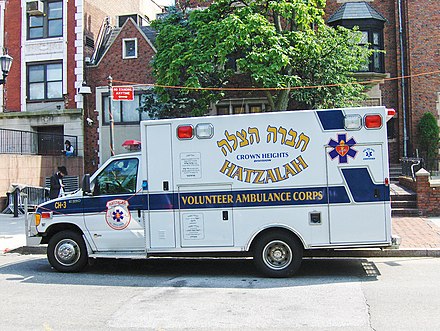
Hatzalah
Hatzalah (/hətˈsʌlə/; Hebrew: הַצָּלָה, lit. 'rescue, relief') is one of several Jewish volunteer emergency medical service (EMS) organizations serving mostly areas with Jewish communities around the world, giving free medical service no matter their religion. Most local branches operate independently of each other, but use the common name. The Hebrew spelling of the name is always the same, but there are many variations in transliteration, such as Hatzolah, Hatzoloh, and Hatzola.
It is also often called Chevra Hatzalah, which loosely translates as "Company of Rescuers", "Group of Rescuers", or "Rescue Squad".
Thursday, October 27, 2022
systematics
Biological systematics is the study of the diversification of living forms, both past and present, and the relationships among living things through time. Relationships are visualized as evolutionary trees (synonyms: cladograms, phylogenetic trees, phylogenies). Phylogenies have two components: branching order (showing group relationships) and branch length (showing amount of evolution). Phylogenetic trees of species and higher taxa are used to study the evolution of traits (e.g., anatomical or molecular characteristics) and the distribution of organisms (biogeography).

Tuesday, October 25, 2022
between Scylla and Charybdis
Being between Scylla and Charybdis is an idiom deriving from Greek mythology, which has been associated with the proverbial advice "to choose the lesser of two evils". Several other idioms, such as "on the horns of a dilemma", "between the devil and the deep blue sea", and "between a rock and a hard place" express similar meanings. The mythical situation also developed a proverbial use in which seeking to choose between equally dangerous extremes is seen as leading inevitably to disaster.

Scylla and Charybdis were mythical sea monsters noted by Homer; Greek mythology sited them on opposite sides of the Strait of Messina between Sicily and Calabria, on the Italian mainland. Scylla was rationalized as a rock shoal (described as a six-headed sea monster) on the Calabrian side of the strait and Charybdis was a whirlpool off the coast of Sicily. They were regarded as maritime hazards located close enough to each other that they posed an inescapable threat to passing sailors; avoiding Charybdis meant passing too close to Scylla and vice versa. According to Homer's account, Odysseus was advised to pass by Scylla and lose only a few sailors, rather than risk the loss of his entire ship in the whirlpool.
Monday, October 24, 2022
Subscribe to:
Posts (Atom)
synanthrope
A synanthrope (from ancient Greek σύν sýn "together, with" and ἄνθρωπος ánthrōpos "man") is an organism that evolve...

-
A canary trap is a method for exposing an information leak by giving different versions of a sensitive document to each of several suspec...
-
A hyperforeignism is a type of qualitative hypercorrection that involves speakers misidentifying the distribution of a pattern found in ...
-
 Nureongi (누렁이) and Hwangu (황구; 黃狗) are Korean terms meaning "Yellow Dog" used to refer to tannish mongrel or landrace of dog in...

